
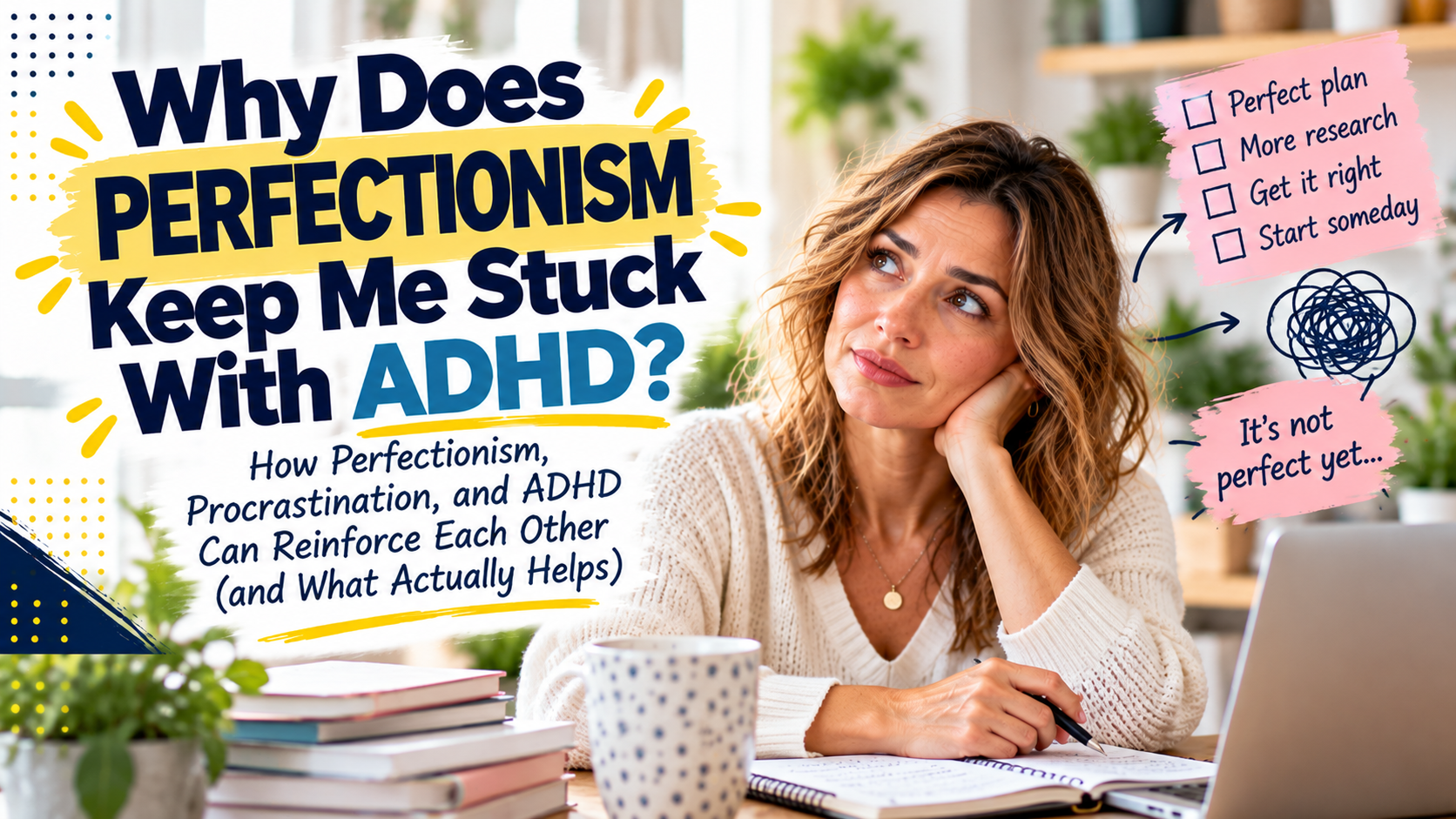
You sit down to do something that matters.
But before you start, you need a better plan. You need to research a little more. You need the right amount of time. You need to know exactly how you are going to do it.
Or maybe you do start—and then spend far too long fixing details nobody else will notice.
Perfectionism can look like high standards. But with ADHD, it can also become one more reason you cannot begin, finish, decide, submit, or move on.
Sometimes perfectionism is not helping you do something well. It is keeping you from doing it at all.
Quick answer: Why does perfectionism keep people with ADHD stuck?
ADHD and perfectionism are not the same thing, and perfectionism is not a diagnostic symptom of ADHD. But they can interact in ways that make executive-function challenges harder.
If starting, planning, estimating time, regulating attention, or deciding when something is “done” is already difficult, adding a rule that you must do it the right way can raise the starting line even higher.
Research on adults with ADHD has described high self-expectations, dissatisfaction with achievement, and a cycle in which overly high targets make it harder to start, procrastination follows, and shame reinforces the pattern. More recent research also continues to find links among ADHD symptoms, procrastination, and perfectionism, although this is an emerging area and perfectionism is not unique to ADHD.
What does ADHD perfectionism look like?
It does not always look like a spotless house or flawless work.
It can look like:
- waiting until you have enough time to “do it properly”
- researching instead of starting
- making elaborate plans you never begin
- rewriting an email five times
- taking three hours to do a task that needed 45 minutes
- avoiding something because you are not sure you can do it well
- having trouble deciding because you want the best choice
- not submitting work because it still does not feel finished
- abandoning a routine after missing one day
- believing that if you cannot do the whole thing, there is little point doing part of it
This is one reason perfectionism can be easy to miss in ADHD. From the outside, someone may look inconsistent or disorganized. Underneath, they may be holding themselves to standards that make action almost impossible.
Perfectionism can become “front-end” procrastination
One especially useful way to think about this is front-end perfectionism: needing the circumstances, plan, energy, information, or approach to feel just right before you begin.
You are not necessarily procrastinating because you do not care.
You may care so much that starting feels loaded.
If the task has to be done exceptionally well, you need more time. More clarity. More energy. More certainty.
And if you do not have those things right now, your brain offers a very reasonable-sounding solution:
I’ll do it later.
This connects directly to ADHD task initiation. The more requirements you attach to starting, the harder starting becomes.
Why perfectionism and ADHD can reinforce each other
1. You may have years of evidence that things get missed
If you have forgotten appointments, overlooked details, lost things, misunderstood instructions, or turned something in late, you may respond by trying to control for every possible mistake.
Check it again. Make sure. Do not mess this up.
That can feel protective. But eventually the protection can cost more than the mistake would have.
2. Inconsistent performance can make you chase your best day
Maybe you know what you are capable of because you have done exceptional work before.
The problem comes when exceptional becomes the minimum.
Instead of asking, “What does this task actually require?” you compare today’s work to the best thing you have ever produced.
ADHD performance can vary with context, energy, interest, stress, sleep, task demands and support. Expecting yourself to reproduce your best performance every time can create a standard no human can sustain.
3. Perfection can protect you from criticism
If criticism or rejection feels especially painful, perfectionism can become armor.
If I do everything right, nobody can be disappointed in me.
That is an impossible bargain. You cannot make yourself rejection-proof by being perfect.
If this is part of your pattern, read Why Does Rejection Hurt So Much With ADHD?
4. ADHD can make “done” surprisingly unclear
Some tasks have obvious finish lines. The dishwasher is either unloaded or it is not.
But many important tasks do not. How much research is enough? When is the presentation ready? How polished should the proposal be?
Without a clear definition of done, perfectionism can keep moving the finish line.
High standards are not the problem
I do not think the answer is to stop caring or lower every standard.
I like standards.
The question is whether your standards are guiding you or judging you.
A useful standard helps you decide what matters and what “good enough” means for this particular situation. An impossible standard keeps changing, requires you to perform at your maximum all the time, or turns one miss into evidence that the entire effort failed.
I talk more about that distinction in ADHD and Standards: Building Guidelines That Actually Work.
What actually helps with ADHD perfectionism?
1. Define “done” before you start
Do not wait until you are tired and deep in the task to decide what enough looks like.
Ask:
What does this actually need to accomplish?
An email may need to be clear, accurate, and kind. It does not need to be the best email you have ever written.
A workout may need to get your body moving. It does not need to be your ideal 60-minute workout.
A first draft needs to exist. It does not need to be publication-ready.
2. Separate minimums from maximums
This is something I use in coaching all the time.
Your minimum is the version that still counts on a hard day. Your maximum keeps you from turning every task into a project.
For example:
- Minimum: work on the proposal for 20 minutes.
- Target: finish the first section.
- Maximum: stop after 90 minutes and reassess.
Perfectionism usually tells you the minimum does not count. It does.
3. Make the first version deliberately incomplete
If your brain wants to perfect while creating, separate those jobs.
Draft first. Edit later.
Brainstorm first. Organize later.
Get the ugly version onto the page before asking it to become good.
This lowers the cost of starting because you are no longer asking yourself to create and evaluate at the same time.
4. Ask what the extra effort is buying you
There is a point where more effort meaningfully improves the result.
And there is a point where you are changing a sentence for the ninth time because stopping feels uncomfortable.
Ask:
If I spend another 30 minutes on this, what will actually be better?
If you cannot name a meaningful benefit, you may be polishing rather than improving.
5. Practice completing things imperfectly
Completion is a skill.
Send the email after two checks instead of six. Leave the closet at 80 percent. Submit the draft that is solid but not flawless. Do the 20-minute workout.
You are teaching your brain that “finished and useful” is a legitimate outcome.
6. Review instead of judging
If something does not go well, perfectionism tends to turn the result into a verdict:
See? I knew I couldn’t do this.
I prefer Review → Revise → Recommit.
What worked? What got in the way? What needs to change? What are you recommitting to now?
That keeps a mistake from becoming an identity.
It also connects to rebuilding self-trust with ADHD: self-trust is not never getting off track. It is knowing you can return.
What I learned from Meditations for Mortals
One reason I started thinking more deeply about perfectionism was Oliver Burkeman’s Meditations for Mortals.
One of the ideas I took from the book is that accepting our limits can be freeing. You cannot do everything. You cannot optimize every area of your life. You cannot wait until everything is caught up before you allow yourself to live.
For ADHD adults, I think that matters.
We can spend an enormous amount of energy trying to finally become the person who never forgets, never falls behind, never needs help, and always follows the plan.
What if the goal is not to become perfect at managing ADHD?
What if the goal is to get better at working with yourself as you are?
You can listen to the original podcast episode here: Meditations for Mortals Explained for ADHD Brains.
Frequently asked questions about ADHD and perfectionism
Is perfectionism a symptom of ADHD?
No. Perfectionism is not part of the formal diagnostic criteria for ADHD. However, research and lived-experience studies suggest perfectionistic patterns can occur in people with ADHD, and they may interact with procrastination, self-esteem, anxiety, executive-function difficulties, and past experiences of criticism.
Why do I procrastinate when I want something to be perfect?
Perfection raises the requirements for beginning. If you believe you need enough time, the right mood, complete certainty, or a flawless plan, starting becomes much harder. Avoidance can temporarily reduce that pressure, which makes procrastination more likely.
Can perfectionism make ADHD paralysis worse?
It can. A task with unclear expectations already requires planning and decision-making. Adding the need to find the “best” way to do it can create even more decisions and make initiation harder.
Is “good enough” just lowering my standards?
No. Good enough should be based on what the task actually requires. A tax return, medical decision, client proposal, text to a friend, and load of laundry do not deserve the same level of precision. Matching your effort to the task is not lowering your standards; it is using them intentionally.
Can ADHD coaching help with perfectionism?
ADHD coaching can help you identify where perfectionism is interfering with action, define realistic standards, create clearer finish lines, work with procrastination and executive-function barriers, and practice returning after things do not go according to plan. Perfectionism can also be connected with anxiety, OCD, trauma, depression, or other mental-health concerns; in those cases, therapy may be important. See ADHD Coach vs. Therapist for more on the difference.
You do not need perfect conditions to move forward
You can care deeply about doing good work without requiring every piece of work to be exceptional.
You can have standards without using them as weapons against yourself.
You can make a decision without knowing it is the perfect decision.
You can start before you know exactly how the whole thing will go.
And you can finish something while you can still imagine ways to improve it.
Sometimes the next level is not doing it better. It is letting it be done.
If perfectionism, procrastination, or all-or-nothing thinking keeps getting in the way of the life you are trying to build, learn more about ADHD coaching with me here.
Research behind this article
Research directly examining perfectionism in ADHD is still developing. This article draws on qualitative research on adults’ lived experiences with ADHD, newer work examining perfectionism and procrastination alongside ADHD symptoms, and the broader adult-ADHD literature on executive-function and self-regulation difficulties.
Qualitative study of the experiences and needs of adults with ADHD
Study examining ADHD symptom profiles, procrastination, perfectionism and student functioning
Research discussing perfectionism and need for certainty in people with co-occurring OCD and ADHD
About the author
Mande John is an ADHD coach and host of the Learn to Thrive with ADHD podcast. She helps adults with ADHD understand their patterns, strengthen executive-function skills, and build practical systems that work in real life. Learn more about Mande.