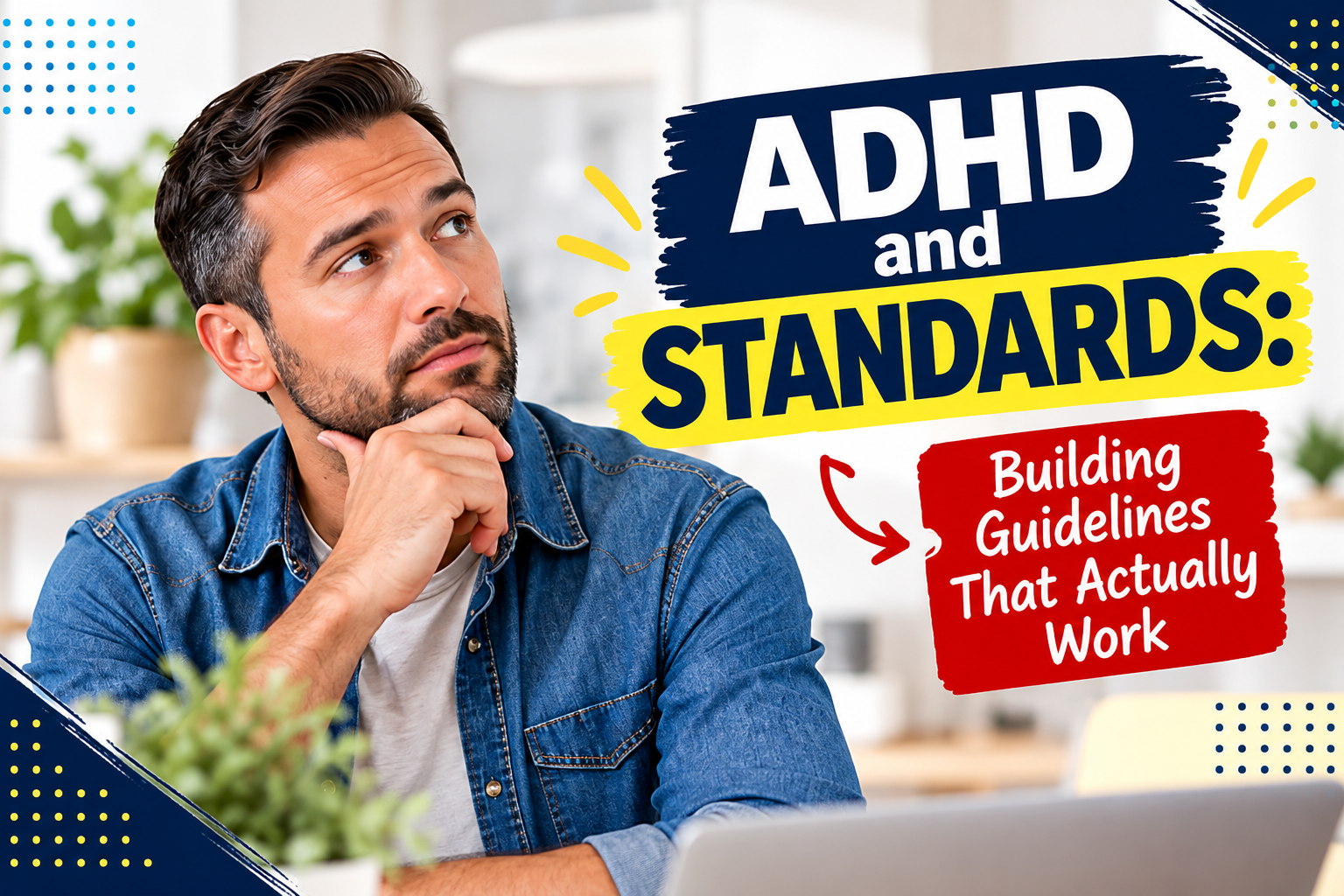
What if the problem isn’t that you don’t have discipline? It’s that your standards are built like a light switch: on or off.
That’s what I see constantly with ADHD. We set a standard—something we want to do or change—miss it once, and our brain labels the whole thing a failure.
I’ve been thinking about this because I own a gym, and I watch people come in and work out consistently. Not perfectly every day, but regularly—Monday through Friday, week after week. When I’ve asked what keeps them coming, the answer is always the same: “It’s simply a standard for me. It’s who I’ve decided to be.”
I wanted to apply this insight to the challenges we face with ADHD, because here’s what I’ve noticed: when we’re not meeting our standards (whether we realize we have them or not), shame shows up. And when shame shows up, we either push harder in an unsustainable way or quit completely.
There’s got to be a bridge between the potential we know we have and where we are now. The question is: how do we sustain crossing that bridge?
Values vs. Standards: Know the Difference
Before you set standards, you need to separate values from standards—they’re not the same thing.
Your values are your deeper why. They’re what matters to you: health, peace, connection, integrity, freedom, being present, stability.
Your standards are the how. They’re the actions you can take and actually measure. They’re the behaviors that prove your values in real life.
Here’s why this matters: if something isn’t measurable, your brain can’t track it. And when your brain can’t track it, you’ll feel like you’re failing even when you’re trying.
Instead of saying “I want to be healthier,” you pick a standard you can point to:
- Protein at breakfast
- Move my body three times a week
- In bed by 11 PM
That’s a standard. You either did it or you didn’t. And if you didn’t, you learn something. Don’t shame yourself.
The Reality Check: Standards Must Match Your Actual Life
Your standards need to match your actual life, not the life you wish you had. Not the version of you that you’re trying to prove. Your real schedule, your real energy, your real season.
When your standard is too big or too rigid, it sets you up for disappointment. The goal isn’t to lower your standards—it’s to set standards you can actually keep so you can build evidence that you show up for yourself.
Here’s one example from my life: I’m proud of my consistency in cleaning my house for 30 minutes a day. I have a clear understanding of what activities happen in that time. Do I do every activity every day? Nope. But I do what I can, depending on the day and my capacity. Do I do it at the same time every day? No. But it has a spot on my calendar that I move if necessary.
Notice it’s not perfect. It’s not “do as planned or forget it.” I’m careful not to slip into all-or-nothing thinking with this activity.
The All-or-Nothing Trap
This is where standards fall apart for all of us. You set a standard, you’re doing it, it feels good—and then you miss it once. Maybe you didn’t work out, slept through your alarm, ordered food instead of cooking.
Your brain doesn’t treat that like a normal human moment. Your brain treats it like proof: “There it is. I knew it. I can’t stick with anything.”
Then shame shows up. And once shame shows up, you usually do one of two things: push harder in an unsustainable way, or disconnect and quit.
Here’s the picture I want you to hold: Your standards are like a steering wheel. They help you stay pointed where you want to go. But the second you drift a little, all-or-nothing thinking says, “Well, I’m off course, I might as well let go of the wheel.”
That’s when one mistake turns into a week of mistakes. One not-perfect meal turns into “forget it, I’ll start over Monday.” One avoided task turns into a pile you don’t want to look at.
That’s not laziness. That’s your brain trying to protect you from feeling bad.
The Real Skill: Notice and Correct
The skill you’re building is not “never drift.” The skill is “notice and correct”—because drifting is normal. The win is how fast you come back.
Instead of asking “Did I fail?” ask “What is my next right step?” Not the perfect step, not the full reset—the next one.
If you need a rule to keep you from disappearing when you miss, use this: Every minute is a restart. No waiting for Monday. You missed today? Okay. How can you shake it off and get back on track ASAP?
One miss is data. It’s information about what got in the way: sleep, stress, overwhelm, planning, emotions, capacity. Don’t use it to judge yourself. Use it to adjust.
Building Flexible Standards: Minimums, Targets, and Maximums
Here’s how you make standards work with your real life: stop making one standard that only works on your best week.
If your standard only works when you’re well-rested, motivated, and everything is calm, it’s not a standard—it’s a perfect week plan. And you don’t live in perfect weeks.
Build standards with a range:
- Minimum: What you do on a hard week
- Target: What you do on a normal week
- Maximum: What you do on a high-capacity week
Minimum is not “I’ll try.” Minimum is specific—a floor you can hit even when you’re tired, overwhelmed, or life is messy.
Examples:
- Value: Health/Movement
- Minimum: 10 minutes of movement
- Target: 3 workouts a week
- Maximum: 5 workouts or an extra long session
- Value: Productivity
- Minimum: 10 minutes to start a task
- Target: One focused work block
- Maximum: Two blocks or finishing the whole thing
Minimum protects momentum. It’s how you avoid the shame spiral that tells you small steps don’t count. Small steps DO count. They’re how you stay connected and keep going.
Maximum matters too. You’ll have weeks where you feel great and want to do a lot. Use that energy, but don’t turn your maximum into your new expectation. One high-capacity week doesn’t mean that’s who you are every week.
Context Matters: Survival Weeks vs. Normal Weeks
Some weeks are what I call survival weeks. Things are off, the schedule is weird, stress is high, sleep is low. Maybe you’re sick, traveling, dealing with family stuff, or facing a deadline.
In those weeks, your job is not to force your target standard. Your job is to stay in the game with your minimum standard. This is where you lead yourself kindly.
Don’t talk to yourself like: “Come on, what’s wrong with you?” Talk to yourself like: “Okay, this is a hard week. We’re doing the minimum. We’re not quitting.”
That’s what builds consistency—not perfection, but staying engaged.
The Reality Check: You vs. Everyone Else
Let’s talk about comparison, because this is a big reason standards can start to feel heavy. You start comparing your real life to what you think other people are doing.
You’re seeing the outside of someone’s life—the parts that look smooth, the highlight reel. You’re not seeing their support, their stress, what they outsource, what they struggle with, or what their brain is like.
If you catch yourself thinking “Why can’t I do what they do?” pause and ask a better question: “What can I do that will make my life work better for me and the people who matter most right now?”
Reality check questions when setting standards:
- Do I actually have time for this on a normal week?
- Do I have support for this? (Reminders, planning, accountability, help)
- Am I in a minimum, normal, or maximum season?
- Am I choosing this because it fits my values or because I’m feeling behind?
The Cycle: Review, Revise, Recommit
When your week doesn’t go as planned (and it will), here’s your tool to restart without falling into all-or-nothing:
Review: What happened? Not what you meant to do or should have done, but what actually happened. Ask: What worked? What didn’t? What got in the way? What helped? Do this like you’re collecting data, not building a case against yourself.
Revise: Decide what needs to change based on what you learned. Usually it’s one of two things: the standard was too high for your season, or support was missing. Revision might sound like:
- “This week my target was too big. My minimum is the goal.”
- “The standard is fine, but I need better support/reminders/scheduling.”
- “This would work better at a different time of day.”
Recommit: Decide what you’re doing next and when. Be specific. Not “I’ll be better” or “I’ll try harder.” Recommit sounds like: “My minimum is ___. My target is ___. And I’m doing it on ___ day at ___ time.”
The restart rule: You start the next available minute or hour. No waiting till tomorrow or Monday. If you miss, you don’t restart your whole life—you do the next thing you can do.
Celebration: How You Build Momentum
If your brain only notices what you didn’t do, you’ll lose momentum. Celebrating progress isn’t fluff—it’s how you build momentum.
When you celebrate, you’re giving your brain proof that your effort matters and creating evidence that you’re showing up for yourself. With ADHD, that evidence is everything.
Redefine what counts as a win:
- Starting
- Doing the minimum
- Finishing one piece
- Making a better choice after a rough moment
- Coming back after you drift (this is a huge skill worth celebrating)
Two simple ways to track wins:
Daily Win (30 seconds): At the end of the day, ask “What did I do today that helps future me?” One thing. It can be small: took my meds, ate protein, walked 10 minutes, sent an email, made an appointment, reset for 5 minutes.
Weekly Wins (2 minutes): Write down three wins each week. You showed up, followed through, completed something, came back after drifting.
If you don’t celebrate progress, you start using shame as motivation. Shame works for about five minutes, then burns you out. You’re not building burnout standards—you’re building sustainable standards.
Your Next Step
Standards are guideposts, not judgments. They help you stay pointed in the direction you want your life to go, even when you’re tired, overwhelmed, or off track.
Here’s what I want you to do next:
- Pick one area: health, home, work, or relationships
- Write your standards: minimum (hard weeks), target (normal weeks), maximum (high-capacity weeks)
- Add one rule: If you miss, do the next step available, no matter how small. No waiting for Monday.
That’s how you build consistency with ADHD—not by never messing up, but by coming back faster.
And before you end each day, give yourself credit for 1-3 things: “What did I do today that helps future me?”
Because it all counts. The small things count. The comeback counts.
What’s one area where your standards have been secretly all-or-nothing? Share in the comments how you might create minimums, targets, and maximums instead.
Need support building sustainable standards? Leave a voice message at speakpipe.com/learntothrivewithadhd with your questions or join the weekly encouragement at www.learntothrivewithadhd.com/weekly.
Listen to the Episode:
Watch the video on Youtube: