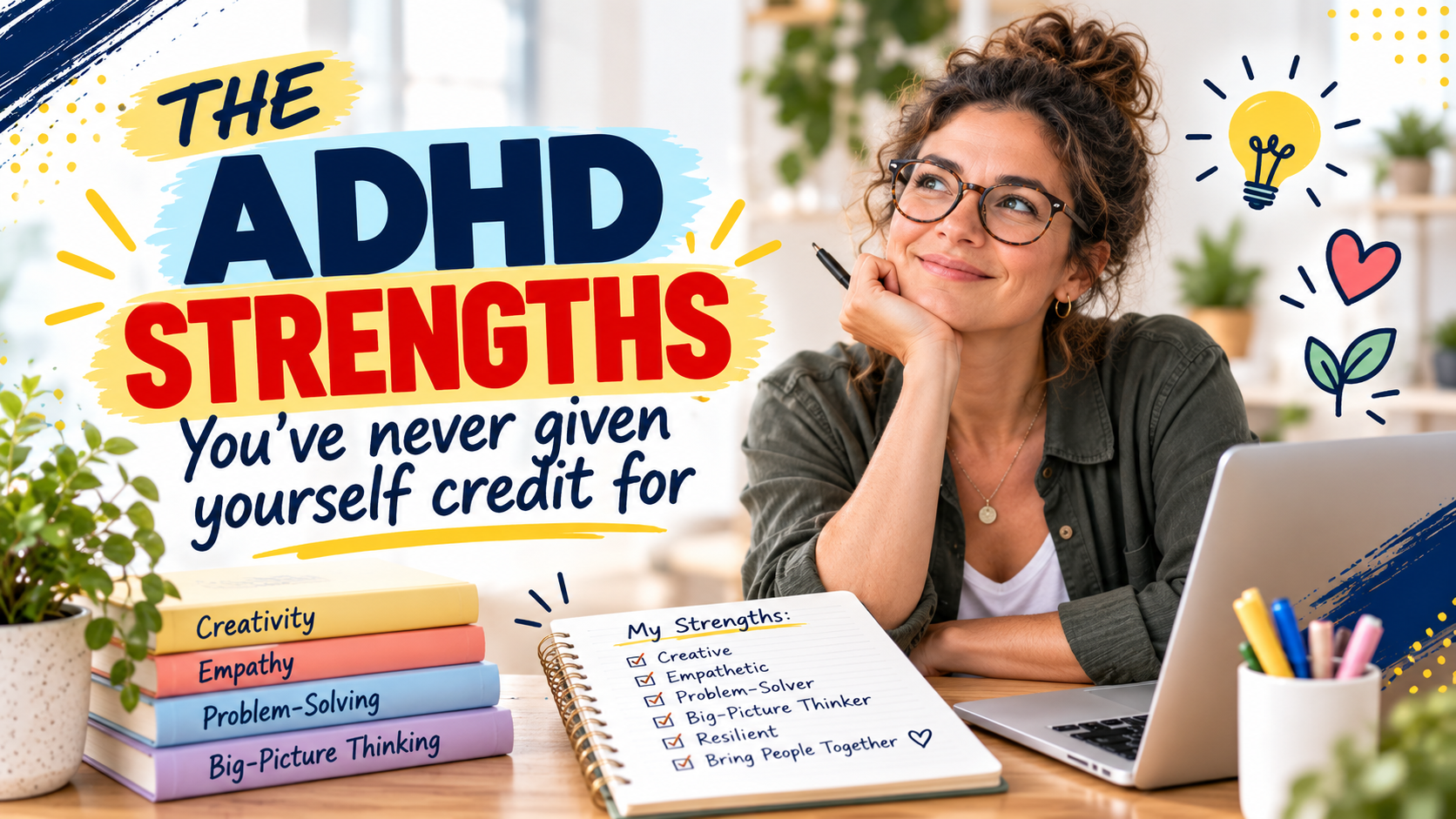
If someone asked you right now to list your ADHD strengths, could you do it?
For a lot of people, that question is harder than it should be. Not because the strengths aren’t there — but because years of missed deadlines, unfinished projects, and quiet self-disappointment have a way of drowning everything else out. When you’ve spent that long focused on what isn’t working, it’s easy to believe that’s the whole story.
It isn’t.
You’ve Probably Been Told the Wrong Story About Yourself
A lot of ADHD adults carry around a version of themselves built entirely out of what went wrong. The forgotten appointment. The project that never got finished. The opportunity that slipped by because it just didn’t get done in time. Over years, that pile of moments turns into a belief: I’m just someone who can’t follow through.
But that belief is built on a partial dataset. It only counts the misses. It never counts the times you noticed something no one else noticed, solved a problem in the moment, or brought an idea into a room that changed the whole conversation. Those moments get filed under “normal” instead of “strength” — because they came easily to you, and things that come easily rarely feel like they should count.
They count.
Why Your Strengths Feel Invisible to You
There’s a simple reason so many people miss their own ADHD strengths: they assume that if something comes naturally, it doesn’t count as a skill. Skills are supposed to be hard-won, right? Something you had to struggle for.
But some of the most useful traits ADHD brains bring to the table were never struggles at all. Seeing connections other people miss. Reading a room quickly. Staying completely present with someone in a crisis. Bringing energy and ideas into a space without even trying. These things can feel unremarkable simply because they’re your normal — but normal-for-you is not the same as normal-for-everyone.
There’s also the environment problem. If you’ve spent most of your life in situations that fight against how your brain actually works — rigid schedules, one-size-fits-all systems, jobs that reward doing things exactly one “right” way — of course the struggle has been the most visible part of you. That doesn’t mean there’s nothing good underneath it. It usually means the right parts of you haven’t had enough room to show up yet.
The Traits That Cut Both Ways
Here’s the part that makes this complicated: the very traits that can become real strengths are the same ones that cause the most trouble when they’re unsupported.
Fast thinking can help you make connections nobody else sees — or it can leave you moving so quickly you can’t slow down enough to figure out what actually matters. Creativity can generate an endless stream of ideas — or it can leave you with a pile of half-finished projects and nothing to show for the energy you poured in. Hyperfocus can let you accomplish an enormous amount in a short window — or it can swallow an entire day while everything else in your life quietly falls apart.
This is why “just embrace your ADHD as a strength” often falls flat as advice. A strength without any support around it doesn’t reliably show up as a strength. It shows up as one more unpredictable thing.
What Actually Turns a Trait Into a Strength
The difference isn’t the trait itself. It’s whether there’s structure and self-awareness around it.
Someone who knows they hyperfocus builds in checkpoints so the rest of their life doesn’t disappear. Someone who knows their ideas outpace their follow-through builds a simple system to catch and sort them before they pile up. Someone who knows their environment shapes their focus stops blaming themselves for distraction and starts changing the environment instead.
None of that requires becoming a different person. It requires becoming an honest one — honest about what actually helps you function and what quietly works against you, instead of continuing to expect yourself to operate like a brain that isn’t yours.
You’re Allowed to See Yourself More Completely
This isn’t about forcing yourself to call ADHD a gift, and it’s not about pretending the hard parts aren’t hard. They are hard. Missed deadlines have real consequences. A disorganized home takes a real toll. Those things deserve honesty, not a positivity script.
But you are not only your missed deadlines. You are not only your unfinished projects. There are things you do well — genuinely well — and the fact that they’ve felt invisible to you doesn’t make them any less real.
Learning to see those strengths clearly, and building the kind of structure that lets them actually show up in your daily life, can change more than how you get things done. It can change how you see yourself.
Want Help Seeing More of What’s Actually There?
If you’re realizing there might be more to your ADHD than the parts you struggle with, that’s exactly the kind of thing I dig into every week — practical strategies, the mindset side of ADHD, and real ways to work with your brain instead of against it.
👉 Get it in your inbox: learntothrivewithadhd.com/weekly
If you want more personalized support figuring out what’s actually going on for you, book a free consultation — I’d love to help.