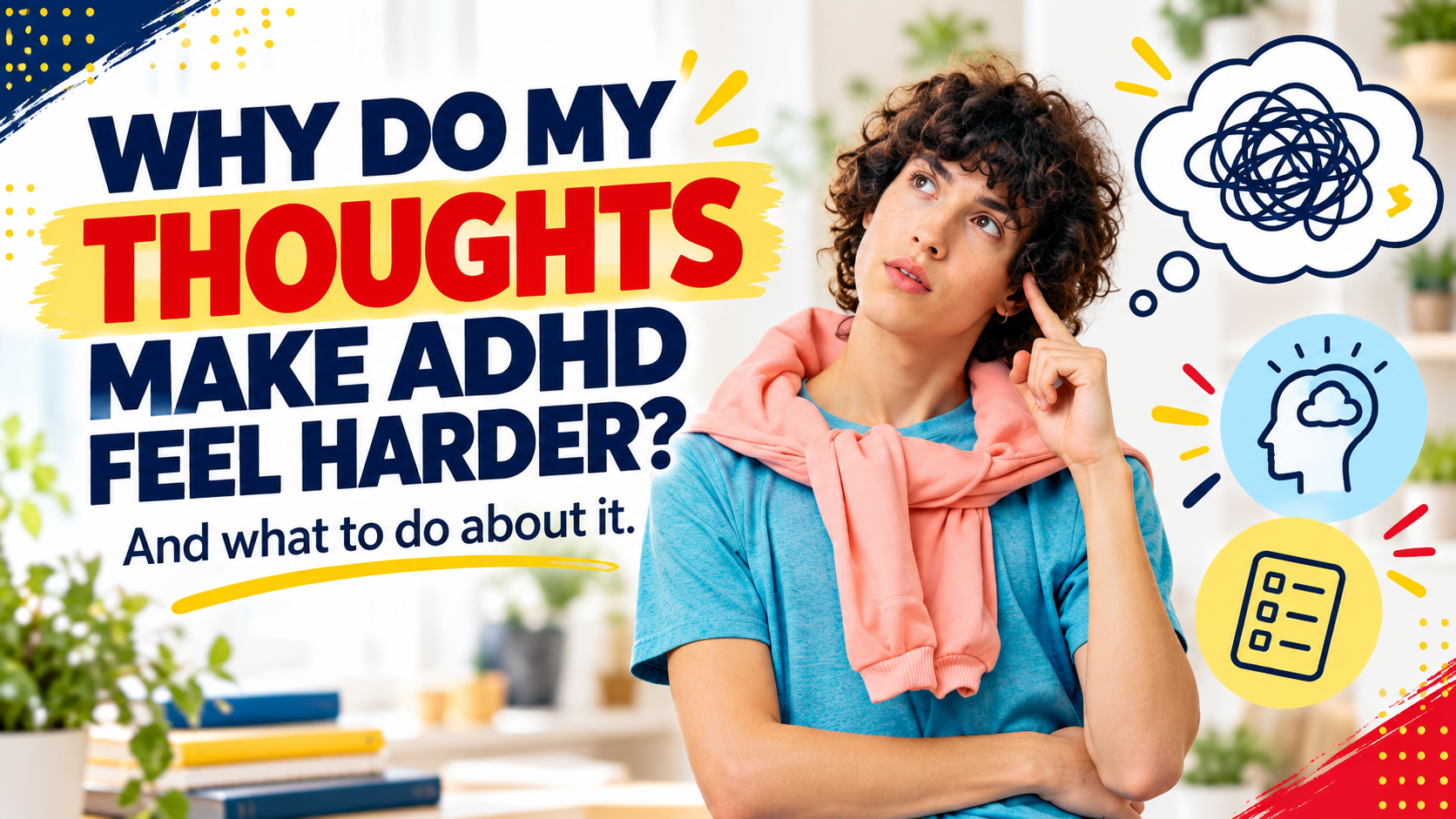
There’s a book I’ve gifted more than any other in my life. I’m guessing I’ve given away over 100 copies over the years.
It’s called Feeling Good by Dr. David Burns. And while it was written for depression and anxiety, it changed the way I looked at my thoughts, my feelings, my world, and other people—in ways I still use today, both in my own life and in my work with ADHD adults.
Here’s what I didn’t know when I first read it in my 20s: years later, when I became a certified ADHD coach, I would be revisiting many of these same ideas. They are now a core part of how I work with people.
Because ADHD isn’t just about planners, routines, reminders, and getting things done. It’s also about the thoughts we have when those things feel hard—when we get stuck, or when we start believing something is fundamentally wrong with us.
How I Found This Book
I found Feeling Good during a really hard season in my 20s. I was newly married and had stopped working for the first time—and that might not sound like a big deal, but I had been working since I was very young.
Working had always been part of who I was. When I stopped, I lost a piece of my identity. I didn’t know what to do with myself, who I was without that structure, responsibility, and sense of purpose. I became really depressed.
I eventually went to see a county psychologist. It wasn’t a good experience. He mostly sat there and stared at me. After a few uncomfortable appointments where I felt completely unsupported, he reached behind me, pulled a bright yellow book off the shelf, handed it to me, and told me I should read it.
I didn’t particularly like him or his method. But I took the book home anyway.
I remember sitting in the corner of my couch, reading the stories and concepts—not the scientific parts at first, just the ideas. And something clicked.
I understood for the first time that my thoughts were creating my feelings. It was what I was thinking that was causing so much of my depression. That realization changed everything.
What This Has to Do with ADHD
ADHD doesn’t just affect what we do. It affects how we feel about what we do. It affects how we interpret our struggles. It affects the stories we tell ourselves when we forget something, procrastinate, lose track of time, avoid a task, or fall out of a routine.
A lot of ADHDers aren’t just dealing with the missed appointment, the messy kitchen, the unopened mail, or the unfinished project. They’re also dealing with the meaning they attach to those things:
- “I’m lazy”
- “I never follow through”
- “I always mess things up”
- “Everyone else can do this—why can’t I?”
And those thoughts matter because they create feelings. They create shame, dread, overwhelm, discouragement, and hopelessness. When we feel those things, it becomes even harder to take action.
That’s why Feeling Good connects so deeply with ADHD. It gives us a way to look at our thoughts underneath the struggle. It helps us see that the problem isn’t just the task, the routine, or the system. Sometimes the problem is the story we’re telling ourselves about what it means when that task feels hard.
And when we can see the story, we can start to question it.
The Two Sides of ADHD Coaching
When people get on a consultation call with me, I explain that my work has two sides.
Side one: Executive function skills. These are the practical skills that help us manage life—organization, planning, prioritization, working memory, task initiation, emotional regulation, time management, goal sustainability, and follow-through. We build, strengthen, support, and sometimes bypass these skills entirely through habits, structures, routines, reminders, body doubling, visual cues, simplified systems, and accountability.
This is what most people expect when they come to an ADHD coach—the calendars, the checklists, the routines, the systems. And it’s absolutely part of the work.
Side two: Mind management. This is where Feeling Good comes in.
Dr. Burns describes it simply: there’s a circumstance, then we have a thought about that circumstance. That thought creates a feeling. The feeling drives what we do—or don’t do. And our actions create the results we get.
This matters enormously for ADHD. We can have the best planner in the world. We can have a perfect routine written down. We can know exactly what would help us. And then somewhere along the way, we get stuck.
Maybe the novelty wears off. Maybe we miss one day and decide it’s all ruined. Maybe we start thinking “here I go again—I never stick with anything.” We feel shame, overwhelm, or discouragement. And we stop.
Not because the system was wrong. Not because we were incapable. But because the thoughts and feelings around the system took us out.
That’s why mind management is so important. It helps us notice what’s happening in the middle. It helps us catch the thoughts that are creating shame or dread before they collapse the whole thing.
Separating the Circumstance from the Story
Mind management helps us separate what actually happened from the story we’re telling about it:
- Circumstance: I missed a day of my workout. Story: I never follow through.
- Circumstance: There are dishes in the sink. Story: I can’t manage my life.
- Circumstance: I forgot to return a text. Story: I’m a bad friend.
Those stories matter because they create feelings. And those feelings drive behavior:
- If I feel ashamed, I might avoid
- If I feel defeated, I might quit
- If I feel overwhelmed, I might freeze
- If I feel hopeless, I might not even try
But if I can catch the thought and question it, I have a chance to create a different feeling. And from that different feeling, I can take a different action:
- “I never follow through” becomes “I missed today—I can restart tomorrow”
- “I can’t manage my life” becomes “My house is giving me information that my systems need support”
- “I’m a bad friend” becomes “I forgot to respond—I can send a simple text now”
For the ADHD brain, the difference between shame and possibility is huge. Shame shuts us down. Possibility opens a door. And when the door opens even a little, we can take the next step.
Common ADHD Thought Distortions
Dr. Burns identifies specific ways our brains distort reality—especially when we’re depressed, anxious, ashamed, or discouraged. When I first read about these, I felt like someone had opened a window in my brain.
Here are the distortions I see most often with ADHD:
All-or-Nothing Thinking
Seeing things as either perfect or failed. Either I followed the routine exactly or I blew it. Either I finished the whole project or I did nothing. Either I’m consistent forever or I’m not a consistent person.
This is brutal for ADHD brains because our performance is naturally more variable. If we interpret every imperfect day as failure, we spend most of our lives feeling like we’re failing.
Overgeneralization
One event becomes evidence for everything. “I forgot this one thing, so I always forget everything.” “I struggled with this one project, so I never finish anything.” “I was late today, so I’m always a mess.”
“I sometimes struggle with time” gives us something to work with. “I’m always a mess” just buries us in shame.
Discounting the Positive
Ten things go right, one thing goes wrong, and our brain builds a whole story around that one thing. Someone compliments us and we think they’re just being nice. We finish part of a task and tell ourselves it doesn’t count because we didn’t finish all of it.
When we discount the positive, we rob ourselves of evidence that we’re growing, learning, and showing up.
Mind Reading
Assuming we know what someone else is thinking. Someone sends a short text—”they must be annoyed with me.” Someone doesn’t respond right away—”they must be upset.”
For ADHDers, especially those who’ve experienced rejection sensitivity or years of correction, this can feel completely automatic. But often we’re reading a story our brain created, not something we actually know.
Fortune Telling
Predicting the future as if it’s already decided. “I’m not going to stick with this.” “This routine will not last.” “There’s no point starting because I know how this ends.”
This can feel protective—like the brain is saving us from disappointment. But it also keeps us from trying, experimenting, and giving ourselves a chance at a different outcome.
Labeling
Taking a behavior and turning it into an identity. “I procrastinated” becomes “I am lazy.” “I lost my keys” becomes “I am irresponsible.” “I interrupted” becomes “I am rude.”
Labels are heavy and they don’t point toward solutions—they just make us feel worse.
A more helpful approach: Keep the behavior separate from the identity.
- “I procrastinate” is something we can work with
- “I’m lazy” feels like a permanent fact
Emotional Reasoning
Believing something is true because it feels true. “I feel overwhelmed, so this must be impossible.” “I fell behind, so I must be failing.”
Feelings are powerful—they feel like evidence. But feelings aren’t always facts. They’re signals, information worth paying attention to, but not always accurate conclusions.
For ADHDers, emotions can arrive fast and strong. We can go from fine to flooded very quickly. Part of this work is learning to pause and ask: “This feels true, but is it true?”
The Triple Column Technique
Dr. Burns teaches a practical tool called the Triple Column Technique:
- Column 1: Write the negative thought
- Column 2: Identify the distortion
- Column 3: Write a more accurate, balanced response
Example 1:
- Thought: “I never finish anything”
- Distortion: Overgeneralization / all-or-nothing thinking
- Balanced response: “I do struggle to finish things, especially when they’re boring, unclear, or no longer interesting. But I’ve finished many things in my life, and I can make this easier by breaking it down or getting support.”
Example 2:
- Thought: “I am lazy”
- Distortion: Labeling / emotional reasoning
- Balanced response: “I’m not lazy. I’m having trouble with task initiation right now. My brain needs more clarity, more interest, more urgency, or a smaller first step.”
Notice: The balanced response doesn’t erase responsibility. It gives us a doorway into problem-solving.
If the problem is “I am lazy,” where do we even go from there?
If the problem is “I need help with task initiation,” now we have something to work with.
Where Executive Function and Mind Management Meet
When we bring both sides together, something powerful happens:
- Notice the thought “I can’t do this” → Answer with “I can do the first two minutes” → Executive function strategy: set a timer
- Notice the thought “I always forget” → Answer with “My working memory needs external support” → Executive function strategy: visual reminder or alarm
- Notice the thought “I never stick with routines” → Answer with “My routines need to be easy to restart” → Executive function strategy: create a minimum baseline version
That minimum baseline version is so important for ADHD. Sometimes we design habits for our best-day brain. But we need routines that can survive real life—a bad night’s sleep, a busy morning, a low-dopamine day, a sick kid, or a day when our brain just isn’t cooperating.
- Instead of “full workout,” the baseline might be: put on shoes and walk for five minutes
- Instead of “clean the whole kitchen,” the baseline might be: clear one counter
- Instead of “write the whole thing,” the baseline might be: open the document and write one sentence
This isn’t lowering the standard in a harmful way. This is creating a path. This is how we build consistency without requiring perfection. And when we pair that with mind management, we stop making the smaller version mean something negative.
Instead of “that doesn’t count” or “I should be doing more,” we start saying: “This is me keeping a habit alive. This is me practicing coming back. This is how I work with my brain instead of against it.”
Action Changes Mood
Another insight from Feeling Good that connects deeply with ADHD: action changes our mood.
When we feel terrible, we tend to do less. When we do less, we feel worse. When we feel worse, it’s even harder to act. And before we know it, our brain is using the lack of action as evidence that we can’t do anything.
This happens constantly with ADHD:
- We avoid the email → the email gets scarier
- We avoid the laundry → the laundry becomes a mountain
- We avoid the project → the project starts to feel impossible
Avoidance provides short-term relief but creates long-term pressure.
The key is to ask: Where can I create a little mastery today? Where can I create a little pleasure today?
Mastery is anything that gives you a sense of accomplishment—opening the mail, putting five dishes away, taking medication, sending one overdue text, getting dressed, making that phone call. These may look small from the outside, but when your brain is overwhelmed, they’re not small. They’re movement. They’re evidence. They’re the beginning of momentum.
Pleasure is anything that gives you enjoyment, comfort, or relief—sitting outside with coffee, listening to music while you clean, walking around the block, texting someone who makes you laugh. Pleasure isn’t the reward you get after being productive. Pleasure is part of emotional regulation. And for ADHD brains, it’s also fuel.
So many ADHDers try to build lives that are all demand and no reward. We make lists full of “shoulds,” create routines that feel like punishment, and build schedules with no room for our actual nervous system. Then we wonder why we rebel against them.
Of course we do. Our brains are motivated by novelty, urgency, challenge, passion, and reward. If we build a life that’s only obligation, we’re going to struggle to stay engaged.
Your Five-Step Practice
Step 1: Notice
When you feel that wave of shame, overwhelm, dread, anxiety, or defeat—pause and ask: “What am I telling myself right now?”
Step 2: Is this a fact or a story?
A fact can be proven. “There are three unpaid bills on the counter” is a fact. “I’m terrible with money” is a story. “I missed a deadline” is a fact. “I always ruin opportunities” is a story.
Step 3: Look for the distortion
Is this all-or-nothing thinking? Am I overgeneralizing? Am I mind reading or fortune telling? Am I labeling myself? Am I discounting what went right? Am I believing something just because I feel it strongly?
You don’t have to identify it perfectly. The point is simply to help your brain loosen its grip on the thought.
Step 4: Answer with something more accurate and useful
Not fake positivity—something believable enough to practice:
- “I am behind and I can choose the next right step”
- “I missed the deadline and I can repair what I can”
- “This is hard for my brain and I can create support”
- “I got off track and I’m learning how to come back”
Step 5: Take one small action
Open the email. Put your shoes by the door. Set a timer for five minutes. Write the first sentence. Put one dish away. Send the simple text. Look at the calendar. Ask for help.
One thing that tells your brain: we’re not stuck forever. We’re moving.
This Is a Practice, Not a Fix
You’re not going to read one book or hear one episode and suddenly never have a harsh thought again. That’s not how the ADHD brain works.
The win is:
- Noticing the thought a little sooner
- Believing it a little less
- Pausing before you spiral
- Answering yourself with a little more truth and kindness
- Taking one small action instead of disappearing into shame
That’s how change happens. We notice the thought. We question the thought. We support the brain. We take the next step.
The tools matter. But the thoughts we have about the tools matter too.
We can support our executive function challenges without shaming ourselves for having them. We can build habits without making one mistake mean we’re hopeless. We can take responsibility without attacking ourselves. We can tell the truth and still be kind.
That combination—executive function support plus mind management—is where the real transformation happens.
What thought has your ADHD brain been using against you lately? Try the triple column technique and share what you discover.
Ready to start questioning your ADHD thought patterns? Join the weekly newsletter at learntothrivewithadhd.com/weekly or leave me a voice message at speakpipe.com/learntothrivewithadhd