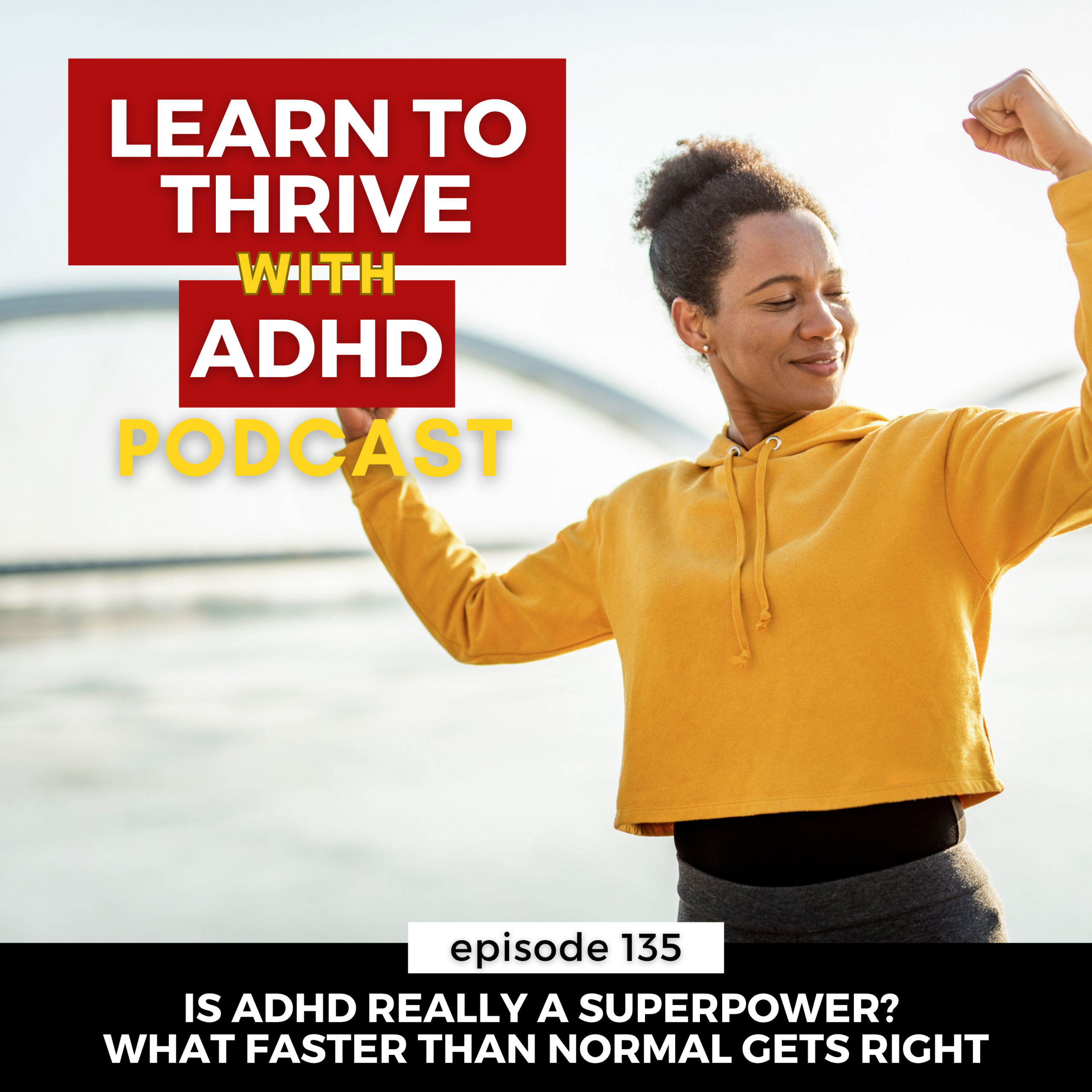




Is ADHD really a superpower? It’s a phrase that gets thrown around a lot, and Coach Mande John has mixed feelings about it. On one hand, there’s real truth in the idea that the thing that makes someone different can also make them powerful. On the other hand, if you’re missing deadlines, your house feels out of control, and you can’t follow through on the things that matter most to you, being told ADHD is a gift can feel dismissive rather than encouraging.
That tension is exactly why this episode looks at Peter Shankman’s book Faster Than Normal — what it gets right about the ADHD superpower conversation, and where the label alone falls short.
The Case for ADHD Superpower Traits
Shankman’s message is that ADHD doesn’t have to be viewed as a disorder that limits you. It can become a powerful advantage once you understand your brain, recognize your triggers, and build your life around how you naturally operate. He points to creativity, speed, spontaneity, and intense focus as traits that, with the right conditions, become genuine strengths.
Mande agrees that ADHD can help build a genuinely interesting life. People with ADHD are often drawn to new ideas, new opportunities, and new experiences. Fast thinking and quick pattern recognition can lead to creativity, risk-taking, and a willingness to do things that don’t make sense to everyone else. Shankman’s own life — building businesses, writing books, speaking globally, completing endurance events — reflects what can happen when that speed is pointed in a direction.
Why “Superpower” Isn’t the Whole Story
But every one of these traits has a flip side. Fast thinking without direction can become overwhelm. Creativity without structure can become a pile of unfinished ideas. Risk-taking without awareness can become impulsivity. Hyperfocus without boundaries can mean neglecting everything else in your life.
This is the core tension in the ADHD superpower conversation: a strength doesn’t stop being a strength just because it sometimes causes a problem — but it doesn’t stop being a problem just because it’s sometimes useful. Both things can be true at once. The goal isn’t to eliminate these traits. It’s to understand when they’re helping you and when they’re starting to work against you, which takes both self-awareness and structure.
Know Your Own Brain
One of the things Mande believes Faster Than Normal gets right is Shankman’s insistence on knowing your own patterns. He doesn’t just claim ADHD has positives — he’s clear that those positives have to be managed. He knows what throws him off, so instead of expecting himself to handle every situation the way everyone else does, he builds his life around what he already knows about himself: he uses deadlines because he needs them, and he pays close attention to sleep, exercise, food, and environment because he knows those things affect how well his brain works.
Mande draws a direct line to her own experience with structure. For years she resisted it, assuming it would feel rigid or boring. Instead, structure became the thing that gave her more freedom — a place to put her ideas, a way to decide what needed attention now versus later, and a way to use hyperfocus without losing everything else in the process.
Rituals Beat Resolutions
A key idea from Faster Than Normal is the difference between resolutions and rituals. Resolutions are based on what we hope we’ll do. Rituals are based on what we actually do, repeatedly — and that distinction matters enormously for ADHD brains, because relying on willpower alone rarely holds up once life gets busy, energy dips, or motivation fades.
Shankman removes decisions ahead of time by limiting choices around clothing, meals, travel, and exercise. Mande does the same in her own life — the same workout clothes in different colors, keeping unhelpful food out of the house — not because of a lack of self-control, but because she knows herself well enough not to create an unnecessary daily battle.
Environment Is Part of the System
Your environment either makes things easier for your brain or harder. Shankman keeps his physical and digital space simple because he knows how quickly distraction can take over. Mande does the same, keeping her space clear because she notices everything around her, whether she’s consciously aware of it or not. She’s also turned off most phone notifications, deciding when she checks in rather than letting apps decide for her — and she’s built support into her environment through coaches, assistants, and editors, because support isn’t separate from ADHD management. It is ADHD management.
The Two-Part Framework: Executive Function and Mind Management
This is where Mande’s own framework comes in. There are two sides to managing ADHD well, and both matter.
The executive function side is the practical part — planning, prioritizing, organizing, starting and following through, managing time, and controlling impulses. Shankman’s routines, deadlines, tracking, and simplified environment all live here. He isn’t hoping he’ll remember or feel motivated. He’s building support around the areas where he already knows he’ll struggle.
The mind management side is how you think about yourself and your ADHD. If you believe structure means being controlled, you may resist the very thing that would help you. If you believe needing support means failing, you may keep trying to do everything alone. You can have the perfect planner and still avoid opening it — because a system alone isn’t enough if your beliefs about yourself work against it.
Strengths You May Have Missed
If you’re listening and thinking, “I don’t see any strengths in my ADHD,” Mande understands that. When you’ve spent years focused on what isn’t working, it’s easy to miss everything else. You may be good at seeing connections, good in a crisis, quick to read people, or deeply committed to the people and things you care about. These strengths often don’t feel special because they come naturally — but that doesn’t mean they don’t count. Sometimes the environment you’re in simply hasn’t given the right parts of you room to show up.
So, Is ADHD Really a Superpower?
Mande’s answer isn’t a simple yes or no. ADHD can make life harder — it can affect planning, follow-through, time management, impulse control, and consistency, and those struggles are real. But that’s not the whole picture. ADHD can also come with fast thinking, creativity, curiosity, courage, and the ability to see things differently.
Those traits can help build a genuinely interesting life, but they still need support to become useful — and that, more than any single label, is what Faster Than Normal gets right. You don’t have to copy Peter Shankman’s exact system. You do need to know your own brain: what helps you function well, what keeps getting in the way, and where you’ve been expecting yourself to thrive in a life that’s been working against you all along.
Keep Learning How to Work With Your Brain
If this episode resonated, Mande shares practical ADHD strategies, client insights, and ways to better understand your brain every week by email.
👉 Subscribe at learntothrivewithadhd.com/weekly
Ready for more personalized support? Book a free consultation with Coach Mande John to talk about private 1:1 ADHD coaching.
Resources:
Links: 🌐 Website: https://www.learntothrivewithadhd.com/
💬 Instagram: https://www.instagram.com/learntothrivewithadhd/
💬 Facebook: https://www.facebook.com/learntothrivewithadhd/
🔗 LinkTree: https://linktr.ee/learntothrivewithadhd
Watch the video on Youtube or Listen to the Episode