Do you ever look around and think, “Why can’t I just stay organized?”
Maybe your desk keeps collecting piles. You lose things even though you swear you put them somewhere safe. You start organizing one area, get pulled into another, and two hours later the original space looks worse. Or maybe the clutter isn’t even physical. Your brain feels cluttered because you’re trying to keep track of appointments, ideas, errands, projects, passwords, papers, and everything else at the same time.
For adults with ADHD, organization usually isn’t just about knowing where things go. It’s about creating systems that make it easier to see what matters, know where things belong, and get back on track when the system falls apart.
Quick answer: How do I get organized with ADHD?
Start by making fewer things depend on memory and decision-making. Give important items a clear home, keep active information visible, break organizing projects into very small sections, and build simple reset routines so disorder doesn’t have to become a full-blown crisis before you deal with it.
The goal is not to create a perfectly organized life. It’s to make your life easier to run.
The National Institute of Mental Health lists disorganization, poor planning, forgetfulness, losing things, and difficulty completing large projects among challenges adults with ADHD may experience. That matters because organization depends on several executive-function skills working together.
Why is organization so hard with ADHD?
Organization can look like one skill from the outside, but it really asks your brain to do a lot at once.
You have to decide what matters, remember where things belong, ignore distractions, estimate how much time a task will take, make decisions about what to keep, and finish the process before something else grabs your attention.
If any one of those pieces gets harder, organization gets harder too.
1. You are trying to hold too much in your head
If your brain is trying to remember everything at once, it becomes much harder to decide what to do with any of it.
This is why I use cognitive offloading so much in my own life and with clients. Get information out of your head and into a place you can see and trust: a calendar, task list, whiteboard, notebook, Trello board, or whatever system you actually use.
You do not need your brain to be the storage unit. You need it to help you think.
2. Too many decisions create friction
Where should this go? Do I need this? Should I keep it? Which drawer? Which folder? What category?
One object does not create much stress. Fifty objects, each requiring a decision, can become exhausting very quickly. If choosing what to keep or where to start leaves you stuck, my guide to ADHD decision paralysis explains how to reduce that friction.
That is one reason simple systems tend to work better. The fewer decisions required to use the system, the easier it is to keep using it.
3. Out of sight can become out of mind
A beautiful hidden storage system is not useful if you forget the things inside it exist.
Some people do better when active items stay visible. That might mean open shelving, clear bins, vertical file holders, a basket by the door, or keeping current projects somewhere they can be seen.
This is not permission to leave everything everywhere. It means building visibility into the system on purpose.
4. Organizing can turn into pinballing
You start in the kitchen. You find something that belongs in the bedroom. In the bedroom you notice laundry. While moving the laundry you see something that belongs in the office. Suddenly you are working in four rooms and have finished none of them.
I call this pinballing.
The solution is not more motivation. It is creating a boundary around the project so you do not have to follow every object to its final destination.
Organize your mind before you organize the room
When everything feels chaotic, I often start with a thought download.
Write down everything your brain is trying to keep track of: work tasks, household things, errands, appointments, ideas, purchases, things you need to remember, things you are worried you will forget.
You are not organizing it yet. You are just getting it out.
Then sort what you wrote into simple categories.
One method I use is the Four N’s:
- Now: needs attention in the current timeframe.
- Next: important, but not yet.
- Not now: something you may want later, but it does not need your attention right now.
- Never: something you can let go of completely.
This is mental organization before physical organization. And sometimes that is the part that gives you the most relief.
How do I organize a messy space without getting overwhelmed?
Do not organize the entire room.
Pick a piece of the room small enough that your brain does not immediately want to run away from it.
That might be:
- one drawer
- one section of the counter
- one shelf
- one category of papers
- ten minutes in the room
If the project still feels too big, make it smaller.
You are looking for a starting point you can actually enter.
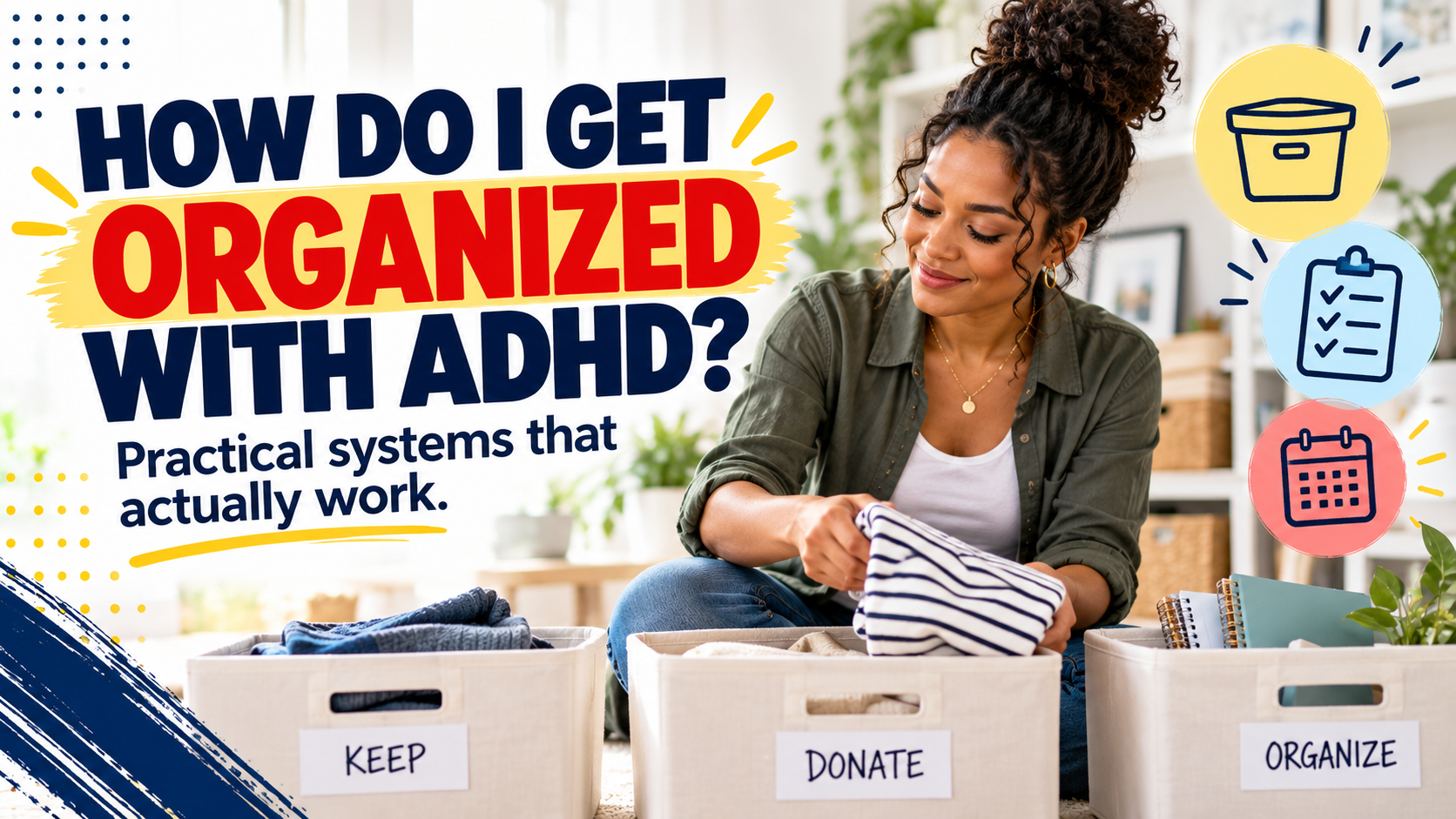
Use the three-basket system
When you are cleaning or organizing, keep three containers nearby:
- Trash
- Give away
- Goes somewhere else
The third basket matters because it stops the pinballing.
If something belongs upstairs, you do not have to walk upstairs and risk getting distracted. Put it in the basket. Finish the area you are working on first. Then deal with the basket afterward.
Give everything a home
A lot of clutter is not really a cleaning problem. It is a decision problem.
If something does not have a home, you have to make a new decision every time you put it down.
Your keys should have a home. Mail should have a home. The papers you are actively using should have a home. Chargers should have a home. The random things that come into the house should have a place to wait until you deal with them.
The home does not have to be Pinterest-worthy. It has to be obvious enough that you will use it.
What kind of storage works best for ADHD?
There is no single ADHD storage system that works for everyone. But I like to ask a few questions:
- Can I see what is here?
- Is it easy to put something away?
- Do I have to move three things to get to it?
- Will I remember this category exists?
- Does the system match how I naturally use the space?
If putting something away takes six steps, there is a good chance it will eventually live on the counter instead.
Make the right action easier.
Use vertical space for active items
Piles are easy to create and hard to read. Once papers stack on top of each other, you can no longer see what is underneath.
For active papers or current projects, vertical file holders can make it easier to see what exists without spreading everything across the desk.
Use clear containers when visibility helps
If you regularly forget what you own, clear containers can reduce the “I forgot that was in there” problem.
Not everything has to be clear. But for categories you frequently lose track of, visibility can make the system easier to use.
What about organizing my car, office, or other problem areas?
Organize for what actually happens in that space.
For a car, ask what repeatedly ends up on the seats or floor. Trash? Receipts? Water bottles? Gym things? Work supplies? Give those categories a home inside the car.
For your desk, ask what you touch every day. Those things should be easiest to access.
For your kitchen, watch where people naturally drop things and build the system around that behavior instead of trying to force everyone to use a system that looks better but never sticks.
How do I maintain organization after I finally get organized?
This is the piece people skip.
Organization is not a one-time project. Your life keeps producing stuff, papers, decisions, laundry, messages, purchases, and unfinished tasks.
You need a way to return the environment to baseline.
That might be a ten-minute evening reset. It might be clearing the kitchen counter after dinner. It might be reviewing papers every Friday. It might be putting the car back together every Sunday.
The exact routine matters less than having one.
And when you stop doing it for a while, that does not mean the system failed. It means it is time to use one of my favorite ideas: Review–Revise–Recommit.
Review what stopped working. Revise the system if needed. Recommit to the next version.
What if I keep getting distracted while organizing?
Make the project smaller and add structure outside your brain.
You can:
- set a ten-minute timer
- write the exact area you are working on before you start
- use the three-basket system so you do not leave the room
- work beside someone else
- use body doubling
- take a picture before you start so you can see progress
For big organizing jobs, body doubling can be especially helpful because another person helps keep the task present. They do not even have to organize with you. Sometimes simply having another person there makes it easier to stay connected to what you decided to do.
Do I need to become a minimalist?
No.
But the more things you own, the more things you have to store, remember, maintain, move, clean, and make decisions about.
So when organization feels impossible, sometimes the most useful question is not “Where should I put this?”
It is: Do I still want to manage this?
You do not have to get rid of everything. You are just deciding whether the item is worth the ongoing job of owning it.
Physical organization and digital organization are related—but not the same problem
If your biggest issue is files, email, passwords, downloads, photos, or digital clutter, that deserves its own system. You can read Digital Organization for ADHD Brains for that.
And if what feels disorganized is really your time—your calendar, tasks, and what to do next—start with How Do I Manage My Time With ADHD?
A simple ADHD organization reset
If you feel completely buried right now, do not try to fix your whole house or your whole life.
- Choose one small area.
- Set a short timer.
- Grab your trash, giveaway, and goes-somewhere-else baskets.
- Give the things you keep a clear home.
- Stop when the timer ends if you need to.
- Decide when you will do the next small piece.
Organization gets easier when you stop treating it like one giant project.
The question I want you to take with you
How can I make this easier to see, easier to use, and easier to put back?
That is a much more useful question than asking yourself why you cannot just be more organized.
Want more support?
If organization, follow-through, or executive-function challenges keep getting in the way and you want help building systems that fit your actual life, learn more about ADHD coaching with Learn to Thrive with ADHD.
About the author: Mande John is an ADHD coach and founder of Learn to Thrive with ADHD. She helps adults with ADHD build practical systems for follow-through, executive function, and creating a life that works for them.