Have you ever had something really important to do—something that could move your business, your life, your work forward—and then suddenly every small task around you became urgent?
The cat box needed cleaning, the laundry needed folding, the dishes needed doing, the inbox needed clearing. The toilet was perfectly fine yesterday and suddenly can’t wait another minute.
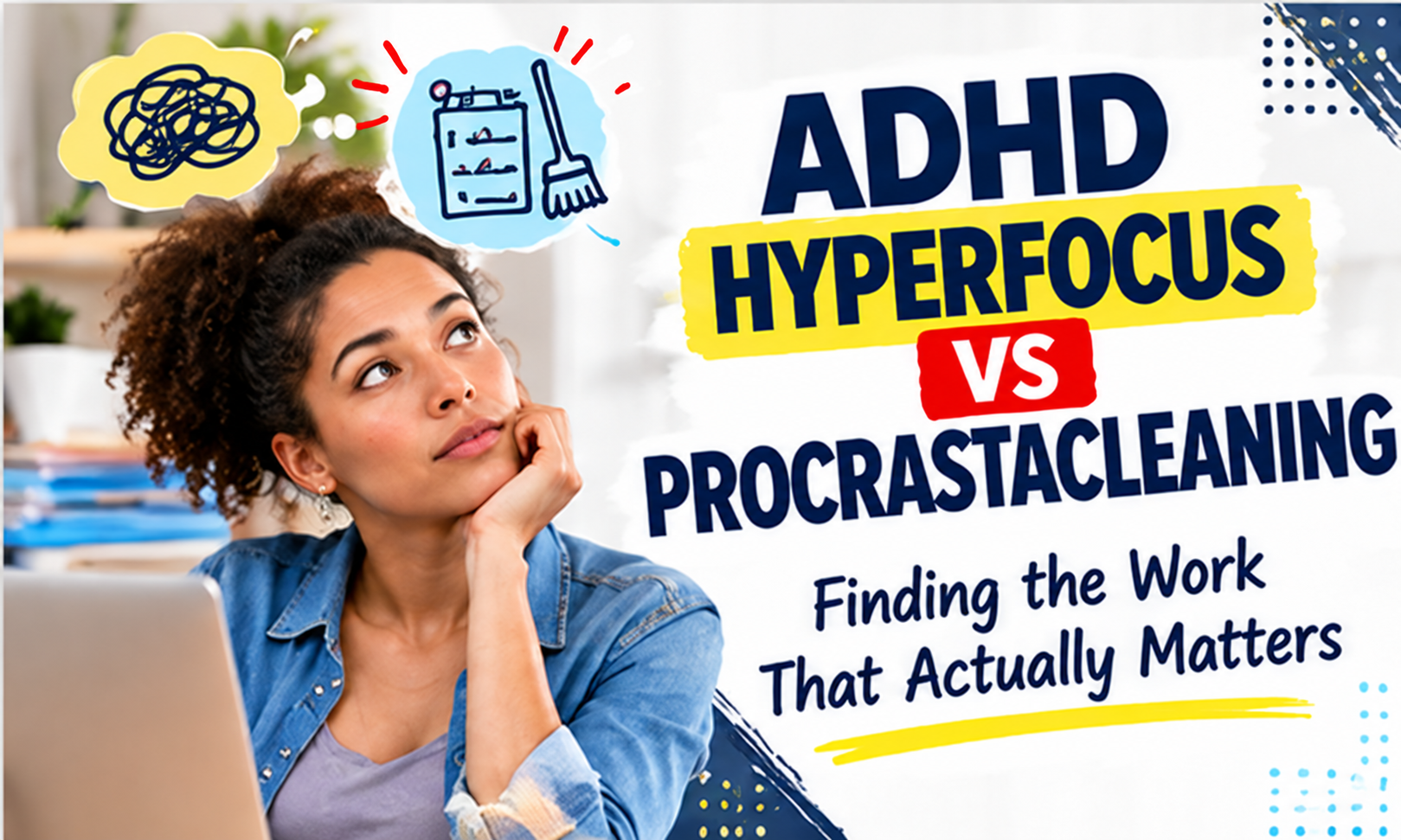
This is what many of us in the ADHD community call “procrastacleaning”—ADHD procrastination with activity. You’re not doing nothing. You’re doing things, sometimes useful things, sometimes things that genuinely need to be done eventually.
But the question is: Are you doing them because they’re the most important thing right now, or are you doing them to avoid the bigger work that actually matters?
Understanding ADHD Procrastination Patterns
ADHD procrastination rarely looks like doing nothing. Instead, it often appears as productive busyness that keeps us away from meaningful work. This form of avoidance can be particularly challenging for ADHD adults because it feels productive.
Paul Graham’s essay “Good and Bad Procrastination” offers valuable insights for managing ADHD procrastination. He suggests that procrastination isn’t always bad—it depends on what you’re procrastinating on.
He describes three types of procrastination:
- Doing nothing
- Doing something less important
- Doing something more important
The third type is “good procrastination”—when you put off smaller tasks to focus on bigger, more meaningful work.
For ADHD adults, this reframe is powerful because it shifts the focus from eliminating procrastination entirely to procrastinating strategically.
The ADHD Procrastacleaning Trap
ADHD procrastacleaning is when you’re active and busy, maybe even productive, but avoiding the work that would create the most impact. It’s procrastination wearing a productivity costume.
Common ADHD procrastacleaning activities include:
- Obsessively organizing digital files
- Achieving inbox zero when email isn’t your primary work
- Researching extensively without taking action
- Creating elaborate planning systems
- Cleaning and organizing physical spaces
- Updating and perfecting existing systems
Because these activities feel productive, ADHD procrastacleaning can be harder to recognize than traditional procrastination.
The key question isn’t “Am I being productive?” but “Am I working on the right thing?”
How ADHD To-Do Lists Become Overwhelm Generators
For ADHD brains, to-do lists can become problematic when they transform from helpful tools into overwhelming masters.
The ADHD to-do list trap occurs when:
- Everything gets equal priority
- The list becomes a dumping ground for anxiety
- Completing list items becomes more important than impact
- The list grows faster than items are completed
Offloading is important—getting tasks out of your head and onto paper, apps, or systems provides relief. But getting something out of your head doesn’t mean it becomes your boss.
The solution is defining “enough.” Without clear boundaries, you’ll keep giving time and attention endlessly to an ever-growing list of tasks.
Why ADHD Brains Avoid Meaningful Work
Understanding why we avoid important work helps us address ADHD procrastination more effectively. Big work often involves:
- Unclear outcomes: No guaranteed results despite effort
- Delayed rewards: Benefits may not appear for weeks, months, or years
- Identity risks: Potential failure feels personal
- Emotional discomfort: Requires tolerating uncertainty, visibility, or being a beginner
- Executive function demands: Complex planning, sustained attention, and follow-through
When work feels emotionally challenging, ADHD brains naturally seek relief through easier, more immediately satisfying tasks.
The key is recognizing that sometimes we’re not avoiding the work—we’re avoiding the emotional load of the work.
Working with ADHD Hyperfocus Productively
ADHD hyperfocus can be incredibly powerful when channeled toward meaningful work. The challenge is maintaining life balance while honoring your brain’s natural patterns.
Healthy ADHD Hyperfocus Guidelines
Instead of: “I can only enjoy hyperfocus after everything else is done” (impossible standard) Or: “I’ll disappear into this and let everything else fall apart” (unsustainable pattern) Try: “This matters to me, I’m allowed to follow this energy, and I’ll maintain basic minimums elsewhere”
Signs ADHD hyperfocus needs boundaries:
- Neglecting basic needs (food, water, sleep, hygiene)
- Avoiding truly important responsibilities
- Damaging relationships through unavailability
- Creating unsustainable life patterns
ADHD hyperfocus minimums might include:
- Regular meals and hydration
- Essential medications
- Key relationship check-ins
- Critical appointments or deadlines
- Basic home maintenance
The goal isn’t perfect balance—it’s protecting the basics that keep future you okay.
The Four Bucket System for ADHD Priority Management
Instead of managing one overwhelming list, try organizing your life into four main buckets for your current season:
Example bucket combinations:
- Family, Business, Health, Home
- Relationships, Career, Money, Creativity
- Parenting, Health, Work, Recovery
For each bucket, ask:
- What is enough here right now?
- What would move the needle in this area?
- Which bucket needs immediate attention?
- What can be simplified, delegated, or eliminated?
This system helps prevent ADHD all-or-nothing thinking while ensuring important areas don’t get completely neglected during hyperfocus periods.
ADHD-Friendly Delegation Strategies
Many ADHD adults resist delegation due to perfectionism or guilt, but strategic delegation is essential for focusing on high-impact work.
Questions for ADHD delegation decisions:
- Does this task require my specific skills or knowledge?
- What is the opportunity cost of my time on this task?
- Could this be simplified, automated, or eliminated entirely?
- Am I holding onto this task for emotional rather than practical reasons?
Common ADHD delegation opportunities:
- Administrative tasks
- Routine maintenance activities
- Research that doesn’t require decision-making
- Social media management
- Data entry or organization
- Appointment scheduling
Remember: Delegation isn’t about tasks being “beneath you”—it’s about finite attention and energy requiring strategic allocation.
Questions to Combat ADHD Procrastacleaning
When you notice yourself in procrastacleaning mode, ask:
- Is this an errand or is this impact?
- Am I doing this because it matters or because it gives me quick relief?
- What is the bigger thing I might be avoiding?
- What feels scary, unclear, or emotionally loaded about the bigger thing?
- What would move the needle in this season of my life?
- What are my four buckets right now, and what is enough in each?
- What can be delegated, automated, simplified, delayed, eliminated, or done “good enough”?
- What is work only I can do?
The most important question, borrowed from Richard Feynman: “What is the most important thing I could be working on, and why am I not working on it?”
Moving Forward with ADHD Awareness
For ADHD adults, the goal isn’t to become machines who complete every task in perfect order. The goal is building lives where attention goes toward what matters most.
This might mean:
- Letting small tasks remain undone to focus on big work
- Following delight and hyperfocus while maintaining minimums
- Delegating more than feels comfortable initially
- Treating to-do lists as servants, not masters
- Regularly redefining “enough” for different life areas
Key insight: Some things will always be left undone. The goal is leaving the right things undone while investing your finite ADHD attention in work that creates meaningful impact.
What meaningful work have you been avoiding through productive procrastacleaning? Share one small step you could take this week toward your bigger goal.
Need support focusing on work that matters? Join weekly ADHD strategies at learntothrivewithadhd.com/weekly or leave questions at speakpipe.com/learntothrivewithadhd