
You know you need to use your calendar. You know breaking big projects into smaller steps helps. You’ve probably heard a hundred times that routines are good for ADHD.
And still, knowing all of that doesn’t mean you’re doing it.
If that’s frustrating, I get it. A lot of people with ADHD have spent years reading books, trying planners, and experimenting with productivity systems. They have plenty of information. What they haven’t figured out yet is how to use it consistently in everyday life.
That’s one of the things ADHD coaching can help with. I talk about coaching all the time, but I haven’t really explained what it is. So I’m starting a six-part series on the podcast about it, beginning with the basics: what an ADHD coach actually does, and what happens when you work with one.
ADHD Coaching Is a Collaborative Process
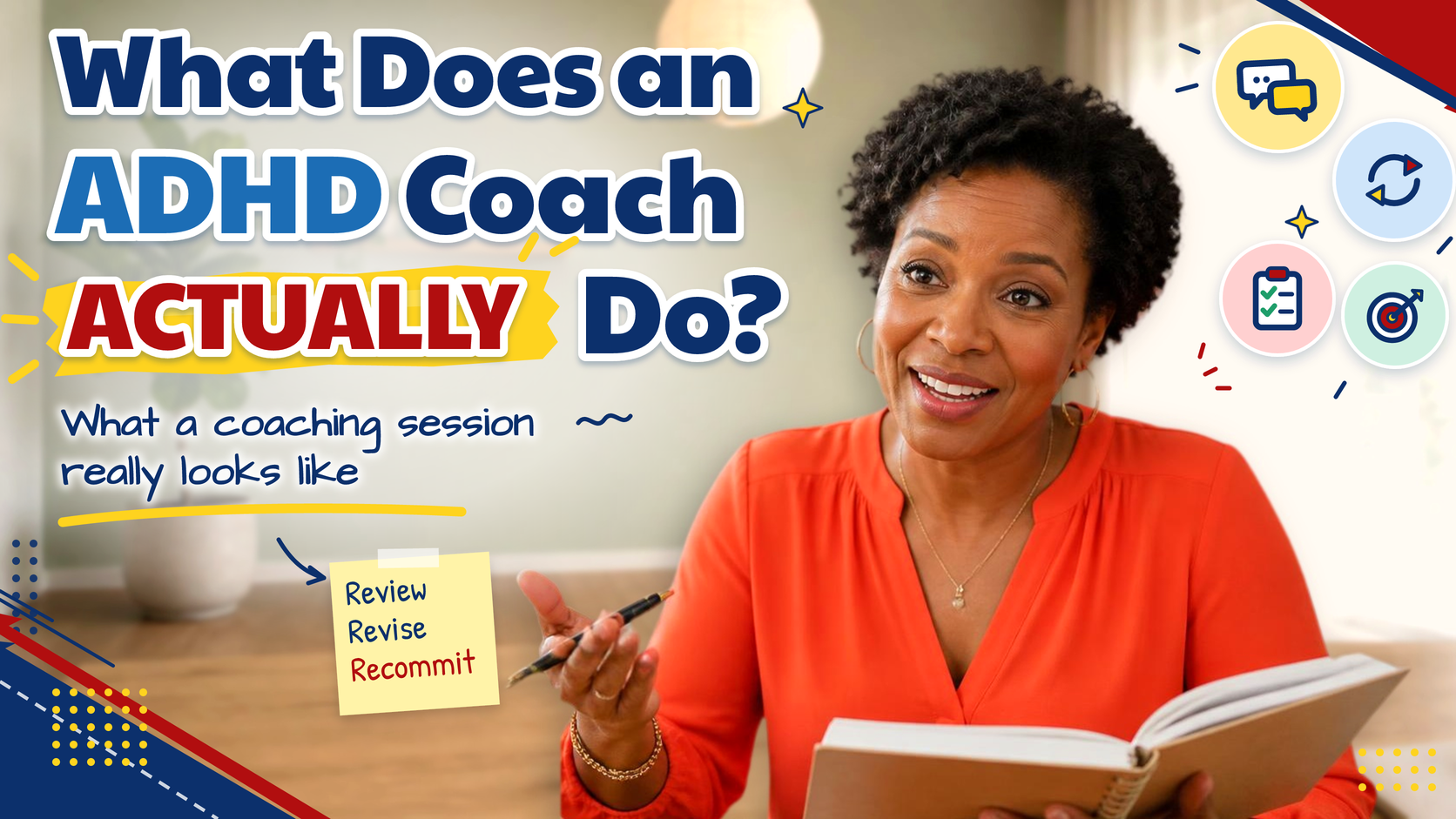
ADHD coaching is a collaborative process that helps you figure out how to manage your life more effectively while working with the way your brain functions.
Collaborative means we work together. Your coach isn’t there to run your life, hand you a schedule, or decide your priorities. You decide what you want to accomplish. Your coach helps you figure out how to get there.
That usually starts with the problem you notice. Say you’re always running late. You assume you need to watch the clock more closely. But when we look at what’s actually happening, you might be underestimating how long it takes to get ready, starting one more task before you leave, or having trouble stopping what you’re doing.
Each of those calls for a different solution. The work is figuring out which advice actually applies to you.
The Gap Between Knowing and Doing
Take going to bed on time. You know sleep matters. You’ve picked a reasonable bedtime. Then it’s 11:00 and you’re still scrolling, watching another episode, or finishing something from earlier.
Telling yourself to be more disciplined tomorrow probably won’t fix it. We need to understand what’s happening between the intention and the action:
- Are you losing track of time? An external reminder could help.
- Is it hard to stop once you’re engaged? We can create a more manageable stopping point.
- Has your evening routine become overwhelming? We can simplify it.
- Is nighttime the only time you get to yourself? Then we look at what’s happening earlier in the day.
The solution depends on the problem.
What a Coaching Session Can Look Like
Imagine you tell me you wanted to exercise three times a week, and you didn’t work out once. You already know exercise is good for you. That’s why you set the goal. So we look at what actually happened.
Maybe you planned to go to the gym after work, but by the time work ended you were exhausted. You went home to change, sat down for a few minutes, and never made it back out the door.
Now we have something to work with. You could bring your gym clothes to work and go straight there. Maybe after work is just a terrible time for you, and mornings or lunch would fit your energy better. Maybe one or two sessions a week is a better start. And maybe you don’t even like the gym. If you love walking outside or riding your bike, we can build a plan around that.
We’re not treating the missed workouts as proof that you’re lazy or undisciplined. We’re using what happened to figure out what needs to change.
Review, Revise, Recommit
That example uses one of the frameworks I use with my clients:
- Review. What was the plan, and what actually happened? We’re looking at facts, not judging whether you were good or bad at following through.
- Revise. Based on what you learned, what needs to change? The timing, the number of workouts, the type of exercise?
- Recommit. What’s the new plan? What are you willing to try before our next session?
Maybe you decide to go straight to the gym after work on Tuesday and Thursday and keep your gym bag in the car. That’s a specific plan we can test. If it works, we build on it. If it doesn’t, we have more information.
Coaching Is More Than Accountability
Accountability is helpful. But if all we did was check whether you completed your assignments, a friend could do that for you.
Coaching goes further. If you tell me you didn’t make it to the gym, I’m not going to tell you to try harder. I want to understand why the plan didn’t work. Did you forget the bag? Work late? Get to the parking lot and couldn’t make yourself go in? Each of those tells us something different.
Over time, you learn to look at your results without turning them into a judgment about yourself. Instead of “I failed again,” you can say, “That plan didn’t work. What needs to change?” That’s a skill you keep long after coaching ends.
Why ADHD-Specific Knowledge Matters
A good life coach can absolutely help someone with ADHD. But understanding ADHD gives a coach more to work with. If you’re struggling to finish a project, an ADHD-informed coach won’t stop at motivation or discipline. Is the project too vague? Does it take a lot of working memory? Are you setting aside an hour for something that will take four?
What Coaching Isn’t
ADHD coaching doesn’t replace medical care, diagnosis, medication management, or mental health treatment. Those are questions for qualified medical or mental health professionals.
A coach also isn’t there to take over. I’m not going to run your calendar or manage your to-do list. You’re the one using the tools and making the decisions.
And a coach shouldn’t make you feel ashamed when something doesn’t work. If you haven’t done anything you planned that week, we still have plenty to work on.
Coaching isn’t magic, either. You’ll still have ADHD. What you build is a better understanding of your patterns and more tools for handling them.
Try It on Your Own This Week
Think about one area where you already know what you need to do, but you’re having trouble following through. Instead of searching for more advice, ask yourself:
- What have I tried?
- What happened?
- What could I change next time?
That’s the kind of problem-solving we practice in ADHD coaching, and you can start doing it on your own.
About This Series (and Working With Me)
This is the first post in my six-part series on ADHD coaching. Next week, I’m talking about ADHD coaching vs. therapy, a question I hear a lot.
I’m also reopening my ADHD group coaching program in November. If you’ve been thinking about getting some support with your ADHD, you can see my coaching options, book a call, or join the group coaching waitlist on my Services page: learntothrivewithadhd.com/services
Would you rather start with practical ADHD tools and ideas you can use on your own? Get on my email list: learntothrivewithadhd.com/weekly