
You sit down to pay bills, answer emails, clean the kitchen, or finally work on the project you have been avoiding.
And somehow, the task feels ten times easier when someone else is there.
They do not have to help you. They may be doing their own work. They may even be on Zoom in another city. If the main challenge is getting started, my guide to ADHD task initiation and paralysis offers additional options.
But their presence changes something.
That is what people mean by ADHD body doubling.
Sometimes you do not need someone to do the task with you. You just need someone there while you do it.
Quick answer: What is ADHD body doubling?
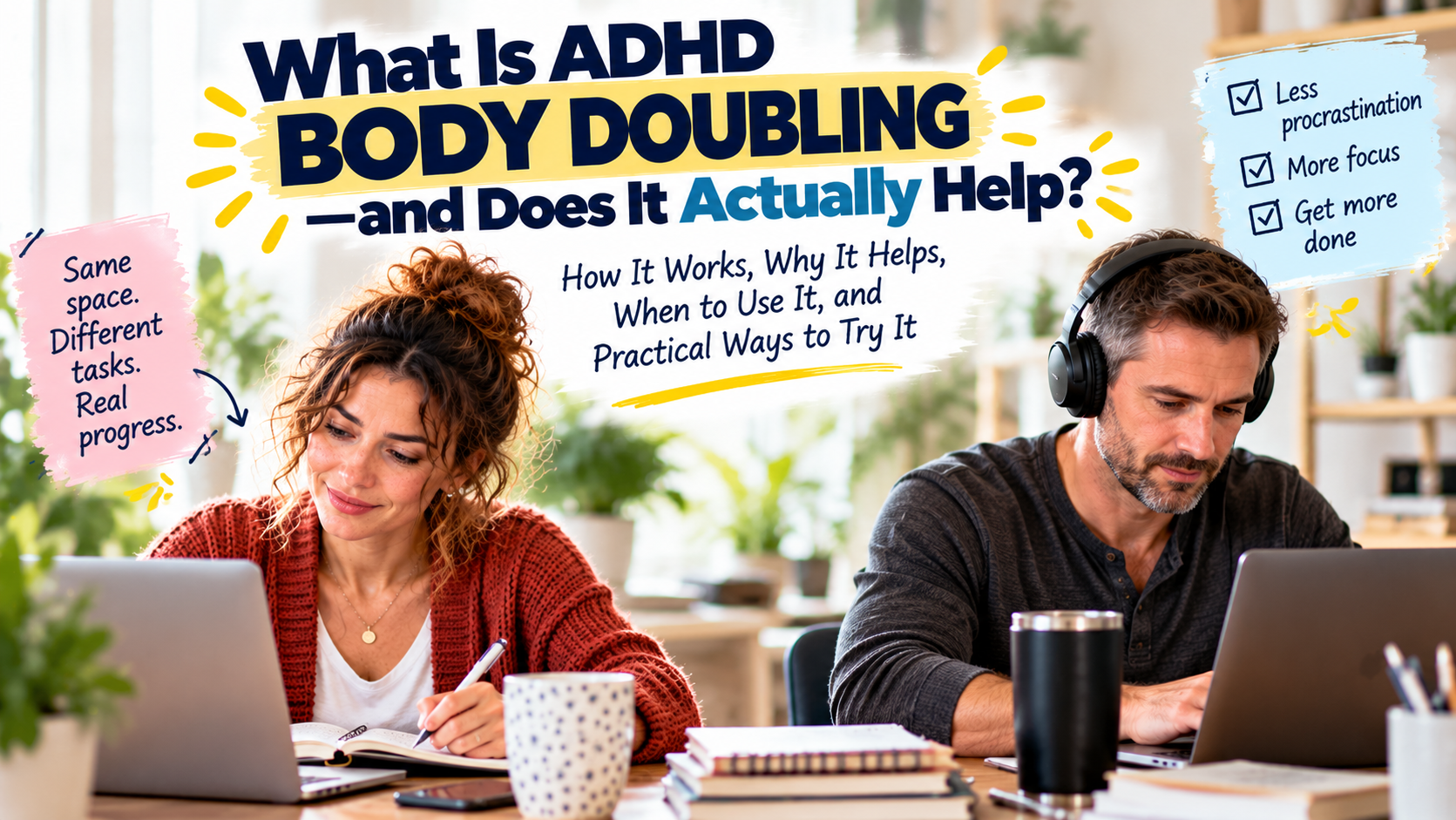
Body doubling is a productivity strategy where another person is present while you work on a task. They might be physically in the room with you or connected virtually by video.
The other person does not necessarily help with the task. Their job is mostly to create presence, structure, and accountability.
For some adults with ADHD, that can make it easier to start, stay with, and finish boring, vague, or easily avoided tasks.
Body doubling is widely used in ADHD communities and coaching, but the direct scientific evidence is still limited. CHADD notes that there has not yet been significant research validating exactly how or why body doubling works. So it is better to think of it as a practical support strategy with strong anecdotal use—not as a proven treatment for ADHD.
What does body doubling actually look like?
It can be very simple.
- You fold laundry while your partner reads nearby.
- You clean the kitchen while a friend works at the table.
- You join a virtual coworking session and work silently for 50 minutes.
- You tell a friend what you are going to do, work independently, and check in at the end.
- You and a coworker each work on your own projects in the same room.
- You stay on Zoom with someone while you both handle paperwork or admin tasks.
The key is that you are not necessarily collaborating.
You are working alongside someone.
Why might body doubling help with ADHD?
We do not have enough direct research yet to say exactly why body doubling works. But there are several plausible reasons it may help.
1. It makes the task more immediate
A task you plan to do “later” can remain vague and optional.
But when you have a 10:00 coworking session with another person, the task suddenly has a time, a place, and a beginning.
That reduces some of the negotiation.
You are no longer asking, “When should I start?”
You already decided.
2. It creates gentle accountability
You may be more likely to follow through when another person knows what you intend to do.
Not because they are policing you.
Because the commitment becomes more concrete.
This is one reason body doubling can overlap with accountability—but it is not exactly the same thing.
3. It reduces isolation
Some tasks feel heavier when you are alone with them.
Paperwork. Taxes. Cleaning. Long projects. Admin. Studying.
Another person’s presence can make the task feel less lonely and less emotionally loaded.
4. It can make distractions easier to notice
If you are working alone, it is easy to wander into email, social media, organizing your desk, or a completely different task without noticing how far you drifted.
When someone else is there working, that shared context can make it easier to come back.
5. It helps create a defined work period
Body doubling often works best when there is a clear beginning and end.
For example:
“We are both going to work for 45 minutes, then check in.”
That gives your brain a container.
The task does not have to feel endless.
Body doubling is not magic—and it is not for everyone
Some people love it.
Some people hate it.
Some people focus better alone.
And the wrong body double can make things worse.
If you choose someone you naturally want to talk to, you may spend the entire session chatting.
If the person feels judgmental, you may feel watched instead of supported.
If you are highly distractible, another person’s movement, noise, or conversation may become one more source of input.
The goal is not to force body doubling because it is popular.
The goal is to notice whether another person’s presence makes the task easier.
Body doubling vs. accountability: What is the difference?
These strategies overlap, but they are not identical.
Accountability usually means someone knows what you committed to and checks whether you did it.
Body doubling means someone is present while you are doing it.
You can have one without the other.
You might use a body double without ever telling them exactly what you are working on.
Or you might have an accountability partner you only speak with once a week.
Many people find the combination especially useful: state the task, work together, then check in.
Body doubling vs. coworking
Coworking can function as body doubling, but not all coworking is body doubling.
The important part is whether the shared work environment helps you activate and stay engaged.
You can body double:
- with a friend
- with a spouse
- with a coworker
- with another person who has ADHD
- in a virtual coworking group
- with a coach during a working session
The person does not have to understand ADHD for the strategy to work.
What kinds of tasks are good for body doubling?
Body doubling is often most useful for tasks that are:
- boring
- repetitive
- easy to avoid
- emotionally loaded
- open-ended
- hard to start
- long enough that attention drifts
Examples include:
- cleaning
- paperwork
- taxes
- laundry
- writing
- studying
- organizing
- meal prep
- business admin
When body doubling helps with task initiation
One of the biggest reasons adults with ADHD use body doubling is to get started.
You can know exactly what you need to do and still have trouble crossing the gap between intention and action.
A body double can shrink that gap because:
- the start time is already chosen
- someone else is expecting you
- you have a defined work period
- the task feels less solitary
If starting is your biggest challenge, read Why Can’t I Make Myself Do Things With ADHD?
When body doubling helps with follow-through
Body doubling can also help after you have started.
You may be able to begin a task but drift away after ten minutes.
Or you may start five things and finish none of them.
Working alongside someone can create enough structure to stay with the task longer.
If your struggle is less about starting and more about staying with things, read Why Can’t I Follow Through With ADHD?
How to try body doubling without overcomplicating it
1. Pick one task
Do not show up with twelve goals.
Choose the thing you are most likely to avoid.
2. Name the first step
Instead of:
“I need to work on my finances.”
Try:
“I am going to open the bank statement and categorize the first ten transactions.”
3. Choose the right person
The right body double is not necessarily your best friend.
You want someone whose presence helps you work.
That may mean someone who is:
- calm
- quiet
- focused
- nonjudgmental
- comfortable working independently
4. Set a time boundary
Try 25, 45, or 60 minutes.
Long enough to make progress.
Short enough that the session does not feel overwhelming.
5. State your intention
At the beginning, say:
“For the next 45 minutes, I am going to finish the first section of this proposal.”
This adds clarity and commitment.
6. Work quietly
The goal is not to turn the session into a meeting.
You do not need constant encouragement.
You just need enough presence to stay connected to the task.
7. Check in at the end
Ask:
- What did I get done?
- Did this make starting easier?
- Did I stay with the task longer?
- What would I change next time?
That is your Review → Revise → Recommit.
Virtual body doubling can work too
You do not have to be in the same room.
Virtual body doubling can be done through Zoom, FaceTime, or a coworking platform.
CHADD has described body doubling done over video as a useful strategy for some adults with ADHD, and many adults use virtual coworking specifically for tasks they tend to procrastinate on.
The structure can be as simple as:
- Say what you are working on.
- Mute yourselves.
- Work for 45 minutes.
- Check in.
Can you body double without another person?
Not technically.
The strategy is built around another person’s presence.
But if another person is not available, you can borrow some of the same elements:
- set a specific start time
- use a visible timer
- state your intention out loud
- join a prerecorded “work with me” video
- work in a library or coffee shop around other people
- send someone a start-and-finish text
Those are not exactly body doubling, but they may create some of the same structure.
Do you need to body double forever?
No.
Use it where it helps.
You may need it for one type of task and not another.
You may use it more during a stressful season and less when life feels stable.
You may use it to start a habit and later find that the habit becomes easier to do alone.
The goal is not independence at all costs.
The goal is to build the support that helps you function.
Frequently asked questions about ADHD body doubling
Is body doubling scientifically proven for ADHD?
Not yet. Body doubling is widely used in ADHD communities and coaching, but direct peer-reviewed research specifically testing body doubling is still limited. CHADD notes that there has not yet been significant research validating its benefits or exactly how it works.
Does a body double have to help me?
No. In most cases, they are simply present while you work. Their presence may create structure, accountability, or a sense of shared effort.
Can body doubling work online?
Yes. Many people use Zoom, FaceTime, or virtual coworking platforms. The other person can be in a completely different location.
What if my body double distracts me?
Then that person may not be a good fit. Try someone quieter, use mute, set clearer rules, or choose a virtual coworking setup with less social interaction.
Is body doubling the same as ADHD coaching?
No. Body doubling is one strategy. ADHD coaching is a broader process that can include identifying patterns, setting priorities, building systems, improving follow-through, and choosing tools such as body doubling when they fit.
You do not have to prove you can do everything alone
Some adults resist body doubling because they think they should be able to do the task by themselves.
I do not think that is a useful standard.
If another person’s presence helps you start the task, stay with it, and finish it, that is useful information.
Support is not cheating. It is part of the system.
Use the support that helps you work.
If body doubling helps, use it.
If it does not, leave it.
The goal is not to use every ADHD strategy. The goal is to figure out which strategies actually make your life easier.
If you want help building practical systems around task initiation, follow-through, motivation, organization, and accountability, learn more about ADHD coaching with me here.
Research and sources behind this article
Direct research on ADHD body doubling is still limited. This article therefore distinguishes between what has been formally studied and what is currently supported mainly by clinical experience, coaching practice, and widespread use in ADHD communities.
CHADD: Could a Body Double Help You Increase Your Productivity?
CHADD: Body Doubling by Skype
CHADD: Levels of Evidence for ADHD Interventions
About the author
Mande John is an ADHD coach and host of the Learn to Thrive with ADHD podcast. She helps adults with ADHD understand their patterns, strengthen executive-function skills, and build practical systems that work in real life. Learn more about Mande.