
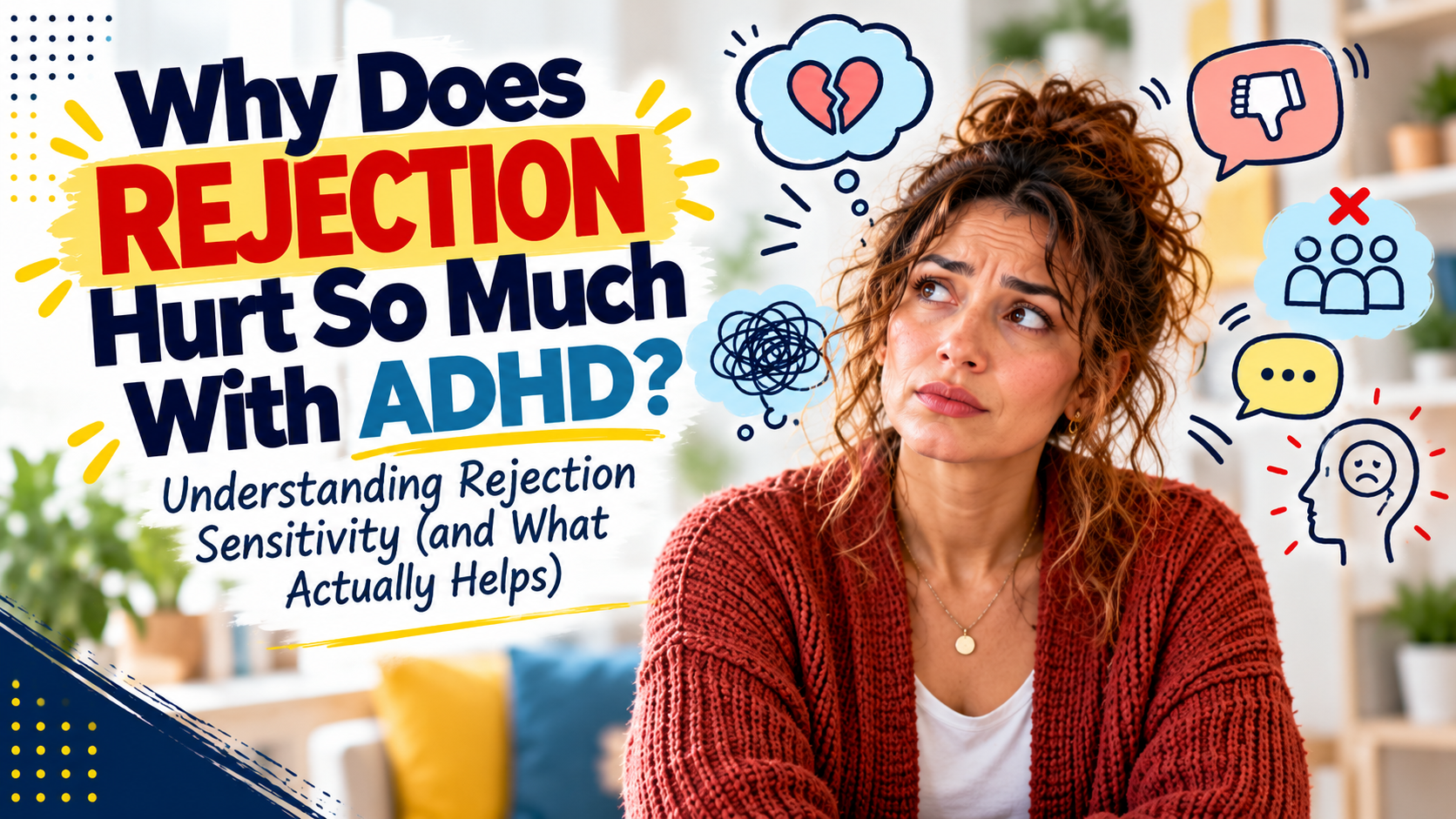
Someone gives you feedback. A friend takes longer than usual to text back. Your boss says, “Can we talk?” A client sounds a little different than normal.
And suddenly your brain is off and running.
They’re upset with me. I messed something up. They don’t like me anymore. I should have known better. I need to fix this right now.
If you have ADHD, rejection can sometimes hit much harder than the situation seems to call for. That experience is often described as rejection sensitivity or rejection sensitive dysphoria (RSD).
The feeling is real. The interpretation may still need checking.
Quick answer: Why can rejection feel so intense with ADHD?
Research on adults with ADHD consistently shows higher levels of emotion dysregulation than in comparison groups. That can include stronger emotional reactions, difficulty recovering once activated, and more intense negative emotional responses.
Rejection sensitivity itself is still an understudied area in ADHD. A recent qualitative study found that ADHD participants described rejection sensitivity as involving anxiety, misery, physical sensations, withdrawal and masking. But the research base is still small, which means we should be careful about treating every painful reaction to criticism as a uniquely ADHD phenomenon.
And one important distinction: RSD is not a formal diagnosis in the DSM. It is a popular term used to describe intense emotional pain around real or perceived rejection, criticism or failure. The experience may be very real even though the label is not an official diagnosis.
What does rejection sensitivity feel like?
It can look different from person to person. You might notice:
- replaying a conversation over and over
- assuming neutral feedback means someone is disappointed in you
- feeling a wave of shame after making a mistake
- wanting to explain yourself immediately
- getting defensive before you have had time to think
- avoiding situations where you might be judged
- people-pleasing to prevent disapproval
- perfectionism because getting something wrong feels emotionally expensive
- withdrawing after criticism or perceived rejection
Sometimes the reaction is sadness. Sometimes it is anger. Sometimes you want to fix the situation immediately. Sometimes you want to disappear from it.
Why might ADHD make this harder?
There probably is not one single explanation.
One piece is emotion regulation. A meta-analysis of adults with ADHD found significantly higher overall emotion dysregulation, with especially strong differences in emotional lability and negative emotional responses. A later systematic review also found that adults with ADHD tend to use less adaptive emotion-regulation strategies more often than adults without ADHD.
Another piece may be learning history. Many adults with ADHD have spent years being corrected, misunderstood, told they were careless, told they were “too much,” or hearing some version of “You’re capable, so why aren’t you doing it?”
That does not mean criticism always causes rejection sensitivity. But if your brain has learned to expect disapproval, you may become very fast at looking for it.
Rejection sensitivity is not the same thing as emotional regulation
These ideas overlap, but they are not identical.
Emotional dysregulation is broader. It can include frustration, irritability, rapid emotional shifts, difficulty calming down, and intense responses to many different situations.
Rejection sensitivity is more specific. It is about how strongly you react to real, anticipated or perceived rejection, criticism, disapproval or failure.
That is why this article connects closely with Why Do My Emotions Feel So Intense With ADHD? but is not the same topic.
And what about RSD?
You will often hear the term rejection sensitive dysphoria, or RSD, in ADHD communities.
It is useful language for some people because it captures how painful rejection can feel. But RSD is not currently an official standalone diagnosis, and there is still limited scientific research directly studying it.
That matters because intense reactions to rejection can also show up with anxiety, depression, trauma histories, personality disorders and other experiences. You do not need to decide that every difficult emotional reaction is “my RSD.” It can be more useful to look at the pattern.
When rejection sensitivity turns into people-pleasing
One way to protect yourself from rejection is to try to prevent it.
You say yes when you want to say no. You over-explain. You check whether everyone is okay with you. You take responsibility for other people’s feelings. You work hard to be easy, helpful and agreeable.
That can create a strange cycle: the more afraid you are of disappointing people, the more you organize your life around avoiding disappointment.
If that sounds familiar, read Why Do People With ADHD People-Please? And How Do You Stop?
When rejection sensitivity turns into perfectionism
Perfectionism can work the same way.
If making a mistake feels emotionally dangerous, perfection can start to feel like protection.
If I do it perfectly, nobody can criticize me.
If I wait until I am completely ready, I cannot fail.
If I double-check everything, maybe nobody will be disappointed.
The problem is that perfectionism often creates more avoidance, more pressure and more opportunities to feel behind.
What do you do in the moment?
When rejection sensitivity gets activated, your first job is not to prove that your interpretation is wrong.
Your first job is to create enough space to think.
1. Name what happened
Start with the event before the story.
What actually happened?
Your boss said, “Can we talk?”
Your friend did not text back for six hours.
Your partner sounded irritated.
You received feedback on a project.
Stay with the observable facts first.
2. Notice what your brain added
Then ask:
What am I making this mean?
They are disappointed in me.
I ruined everything.
They are going to leave.
I should not have said anything.
Everybody thinks I am incompetent.
This is where cognitive fusion can make things harder. A thought can feel so true that it stops feeling like a thought. If that is familiar, read What Is Cognitive Fusion?
3. Slow the response
You do not have to reply to the email immediately. You do not have to send the three-paragraph explanation. You do not have to fix the relationship in the next five minutes.
Give the emotional intensity time to come down before you decide what action is actually needed.
4. Ask what else could be true
Not what is definitely true. Just what else is possible.
Maybe they are busy.
Maybe the feedback is about the work, not about me.
Maybe my partner is tired.
Maybe this conversation is uncomfortable without being catastrophic.
Maybe I made a mistake and I can repair it.
5. Decide what actually needs to happen next
Once you are calmer, ask:
What is the next useful thing to do?
Maybe you need to ask a clarifying question. Maybe you need to apologize. Maybe you need to wait. Maybe nothing needs fixing at all.
You do not have to get rid of the feeling before you can respond differently
This is important.
You may still feel rejected even after you realize you do not have enough evidence to know what someone meant.
The goal is not to talk yourself out of every feeling.
The goal is to notice the feeling without automatically letting it make the next decision for you.
That is a skill. And like most ADHD skills, it gets easier with practice rather than perfection.
What if you were actually rejected?
Sometimes the rejection is real.
Someone does not choose you. A relationship ends. A client says no. You do not get the job. Someone is disappointed in you.
The work is not to pretend that does not hurt.
The work is learning that rejection can hurt without becoming proof that something is wrong with you.
You can be disappointed and still trust yourself. You can make a mistake and still be capable. You can lose an opportunity and still move forward.
If rejection has made it hard to trust yourself, How Do I Rebuild Self-Trust With ADHD? is a good next read.
Frequently asked questions about ADHD and rejection sensitivity
Is rejection sensitive dysphoria a real diagnosis?
No. RSD is not currently a formal standalone diagnosis. It is a descriptive term used for intense emotional pain related to rejection, criticism or failure.
Is rejection sensitivity a symptom of ADHD?
Rejection sensitivity is not one of the formal diagnostic criteria for ADHD. However, emotion dysregulation is common in adults with ADHD, and emerging research is beginning to examine rejection sensitivity more directly.
Why do I take criticism so personally with ADHD?
For some adults with ADHD, emotional reactions happen quickly and intensely. Past experiences of frequent correction or criticism may also shape what you expect in current situations. But criticism sensitivity is not specific to ADHD, so it helps to look at your full pattern rather than assuming ADHD is always the cause.
Can rejection sensitivity cause people-pleasing?
It can contribute. If disapproval feels especially painful, you may start trying to prevent it by keeping everyone happy, avoiding conflict or over-explaining yourself.
Can therapy or coaching help?
Therapy can be especially helpful when rejection sensitivity is connected with anxiety, depression, trauma, relationships or other mental-health concerns. ADHD coaching can help with noticing patterns, slowing reactions, building self-trust, practicing communication and creating strategies for situations that repeatedly trigger you. If you are unsure which type of support fits, see ADHD Coach vs. Therapist: Which Do You Need?
You can feel the sting without handing it the steering wheel
Rejection may still hurt.
Criticism may still sting.
Your brain may still jump to the worst-case story faster than you would like.
But you can build a pause between the feeling and what you do next.
The feeling is real. The interpretation may still need checking.
Notice what happened. Notice what your brain added. Give yourself time to settle. Then decide what the next useful step actually is.
If rejection sensitivity, emotional intensity, people-pleasing or self-trust are making everyday life harder, learn more about ADHD coaching with me here.
Research behind this article
This article draws on research on emotional dysregulation in adult ADHD and emerging research on rejection sensitivity in ADHD. The direct evidence on rejection sensitivity and RSD is still limited, so the article avoids treating RSD as an established diagnostic entity.
Meta-analysis of emotion dysregulation in adults with ADHD
Systematic review of emotion dysregulation in adult ADHD
Qualitative study of lived rejection sensitivity in ADHD
Cleveland Clinic overview of rejection sensitive dysphoria
You can also listen to my earlier podcast episode Rejection Sensitivity Dysphoria (RSD) and my coaching conversation with RJ Issac on call anxiety and rejection sensitivity.
About the author
Mande John is an ADHD coach and host of the Learn to Thrive with ADHD podcast. She helps adults with ADHD understand their patterns, strengthen executive-function skills and build practical systems that work in real life. Learn more about Mande.