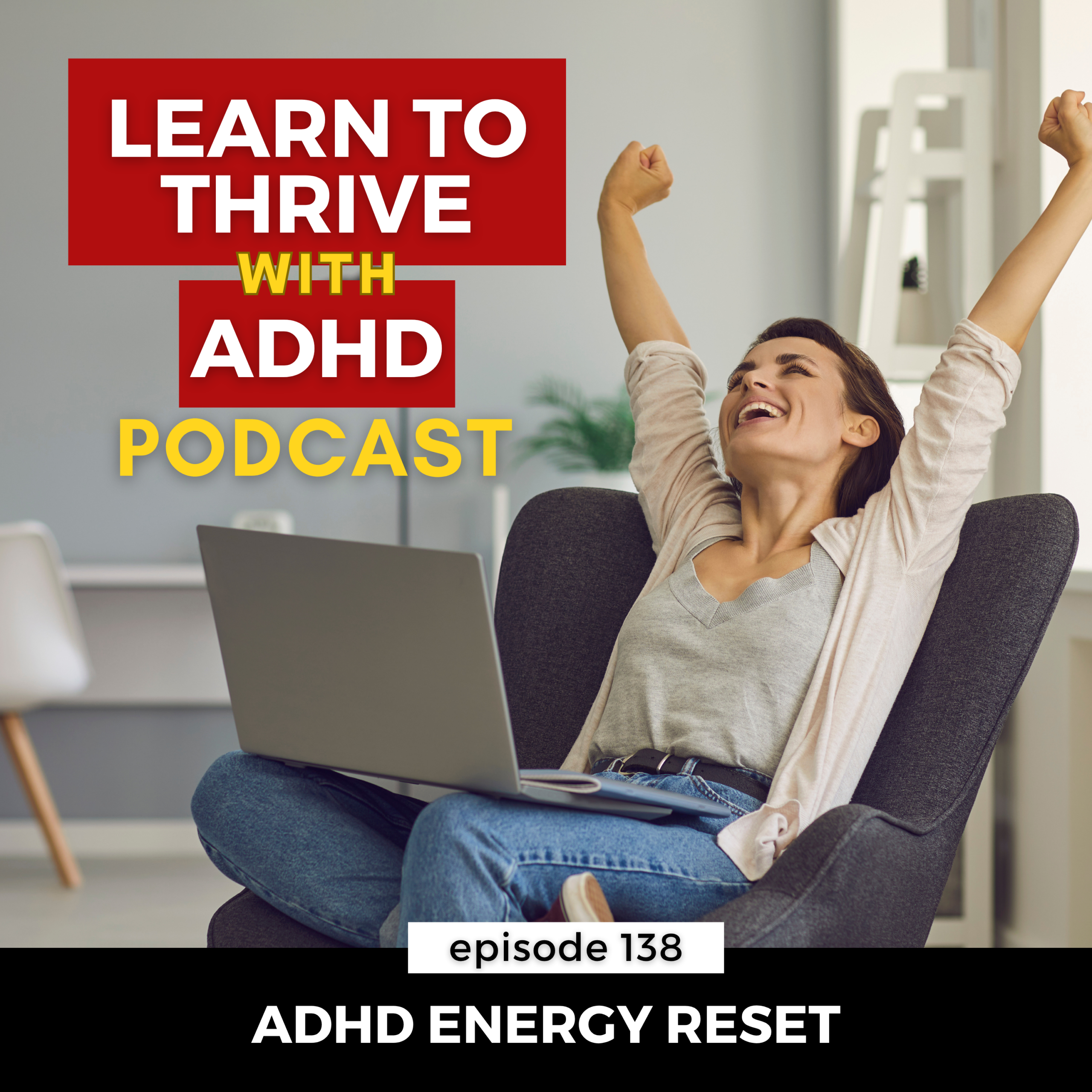


Coach Mande John got on a coaching call last week feeling mentally and physically exhausted. She was tired from a new, high-energy puppy, tired from moving big projects forward, and tired from feeling like everything was taking more out of her than she had to give. By the end of the call, nothing in her life had actually changed — the puppy was still there, the projects were still there — but she got off that call with more energy and a clearer head. That shift is exactly what this episode digs into: ADHD mental energy, and how much of it gets spent not on our tasks themselves, but on what we think about them.
Why ADHD Already Asks So Much of Your Energy
ADHD takes a lot of energy just to get through normal life. Starting something, switching tasks, remembering what you were doing before an interruption, making decisions, figuring out what to do first, managing time, and staying focused all take more effort than most people realize. Even good systems still cost some energy to run. Add regular life on top — work, family, relationships, laundry, appointments, groceries — and it’s easy to see why ADHD mental energy matters so much.
We often measure energy only by sleep or physical activity. But there’s a mental layer running underneath all day: thinking about how much we have to do, feeling upset that something’s harder than it should be, or already deciding how exhausting a task will be before it’s even started. None of that means anything is wrong with you. Brains are built to conserve energy — which is exactly why it’s worth noticing when you’re adding extra weight to something already difficult.
The Story We Add to What Actually Happened
There’s what’s actually happening, and then there’s everything we think about what’s happening — and those are often two very different things. In Emotional Agility, Susan David describes how our brains constantly build stories to make sense of events. Sometimes we get so caught up in the story that we lose track of where the facts end and the story begins.
Take a puppy accident on the floor. The fact might simply be that it happened again after a walk outside. The added story might be, “I can’t get anything done because of this dog. This is exhausting. This is never going to end.” Now you’re not just dealing with the accident — you’re carrying everything you added to it, too.
ADHD works the same way. Some parts really are harder, and there’s no need to pretend otherwise. But thoughts like “why does this have to be so hard for me?” or “everybody else can do this” pile extra weight on top of an already real difficulty. It’s not about banning those thoughts — they’ll show up regardless. It’s worth asking what they’re actually costing you.
“I Have To” vs. “I Get To” vs. “I Choose To”
One shift that’s made a real difference for ADHD mental energy is language: swapping “I have to” for “I get to,” or more often, “I choose to because.” “I get to” works when it’s genuinely true. But standing there cleaning up after a puppy doesn’t always feel like a gift, and forcing that framing can feel dishonest.
“I choose to” works differently. It doesn’t require pretending something is fun. “I’m choosing to train this puppy because I want her in my life.” “I’m choosing to work on this project because I care about what I’m building.” “I’m choosing these systems because I want life to work better with my ADHD.” None of that makes the task itself easier. It reconnects you with the reason you’re doing it, which changes the felt weight of carrying it.
When a Thought Starts to Feel Like a Fact
In The Happiness Trap, Russ Harris describes cognitive fusion — what happens when a thought stops feeling like something your brain generated and starts feeling like an established fact. “This is going to take forever.” “I can’t do this.” “I don’t have enough energy.” Those statements can feel completely true before a task has even started.
One simple way to create distance is to notice the thought as a thought: “I’m having the thought that this is going to take forever” is different from “this is going to take forever.” That framing doesn’t require arguing with the thought or convincing yourself something will be fun. It just leaves room for the next honest question to be simpler: not “how am I going to get all of this done,” but “what’s the next thing?”
Choice Doesn’t Mean You Chose Everything
Choice can change how something feels, even when the circumstances themselves don’t change. That doesn’t mean everything was a choice. Nobody chooses to have ADHD, and plenty of things happen to people that they’d never have picked for themselves. But not choosing what happened and having zero remaining choices are two different situations.
You may not have chosen ADHD, but there’s still choice in what having it comes to mean. You can spend energy resenting that your brain doesn’t work like everyone else’s — or you can acknowledge what’s genuinely harder, learn what helps, build around the brain you actually have, and keep moving toward the life you want. None of that requires calling ADHD a gift if that’s not how it feels. It simply means deciding how much energy is worth spending fighting something that’s already true. And choice isn’t permanent — you can always change your mind, adjust the plan, or ask for help later.
Real Tiredness vs. Added Weight
None of this means “just think better thoughts” when you’re exhausted. Sometimes you’re genuinely tired — under-slept, overextended, or simply in need of rest, food, or help. That’s real, and it deserves to be honored rather than argued with, especially since ADHD can already come with a habit of pushing through and then questioning whether rest is even allowed.
What’s worth noticing is the layer that sometimes sits on top of real tiredness. Being tired because a puppy interrupted your sleep is one thing. Spending the next six hours thinking about how tired you are, how far behind you’ll fall, and how little energy you have left for anything is a second, separate thing — one that adds real weight without adding any real rest. After that coaching call, nothing physical changed. No extra sleep appeared. But there was more energy available, because some of what felt like exhaustion had actually been the weight added on top of it.
A Few Questions to Ask When Something Feels Too Heavy
The next time something starts to feel heavier than it should, a short set of questions can help sort real weight from added weight:
- What is actually true right now — not what I’m afraid will happen, not what this reminds me of?
- What am I thinking about this, and is it the same thing as what’s actually true?
- Is what I’m thinking making this heavier than it already is?
- What part of this isn’t my choice?
- Where do I still have choice — in what I do next, in asking for help, in changing the plan, in taking a break?
- What am I choosing right now, and why?
- What do I want to do next — not how do I fix everything, just the next thing?
That last question connects directly back to a theme from last week’s episode: big things move forward through small actions. Those actions still take energy, so it’s worth not spending that energy convincing yourself in advance that everything is harder than it actually is.
Your Energy Is a Resource
ADHD mental energy is limited, and ADHD already asks a lot of it. When something starts to feel unusually heavy, getting curious about what’s actually happening — before deciding you can’t do it or don’t have the energy for it — can free up more than expected. Sometimes the honest answer really is, “I’m exhausted and I need rest.” Sometimes there’s more available than your brain was telling you there was. Both answers are useful. The point is finding out which one is true before assuming the worst.
Grab the Free ADHD Energy Worksheet
To work through these questions for yourself, grab the free ADHD Energy Worksheet — built with these exact prompts, for the moments when something feels heavier than it should, when you’re feeling drained, or when you catch yourself thinking, “I just can’t deal with this.”
👉 Download it at learntothrivewithadhd.com/adhdenergy
Ready for more personalized support? Book a free consultation with Coach Mande John to talk about private 1:1 ADHD coaching.
Resources:
🌐 Website: https://www.learntothrivewithadhd.com/
💬 Instagram: https://www.instagram.com/learntothrivewithadhd/
💬 Facebook: https://www.facebook.com/learntothrivewithadhd/
🔗 LinkTree: https://linktr.ee/learntothrivewithadhd
Watch the video on Youtube or Listen to the Episode