

Have you ever had something really important to do – something that could move your business or your life forward – and suddenly every small task around you became urgent?
The laundry. The inbox. The toilet that was perfectly fine yesterday.
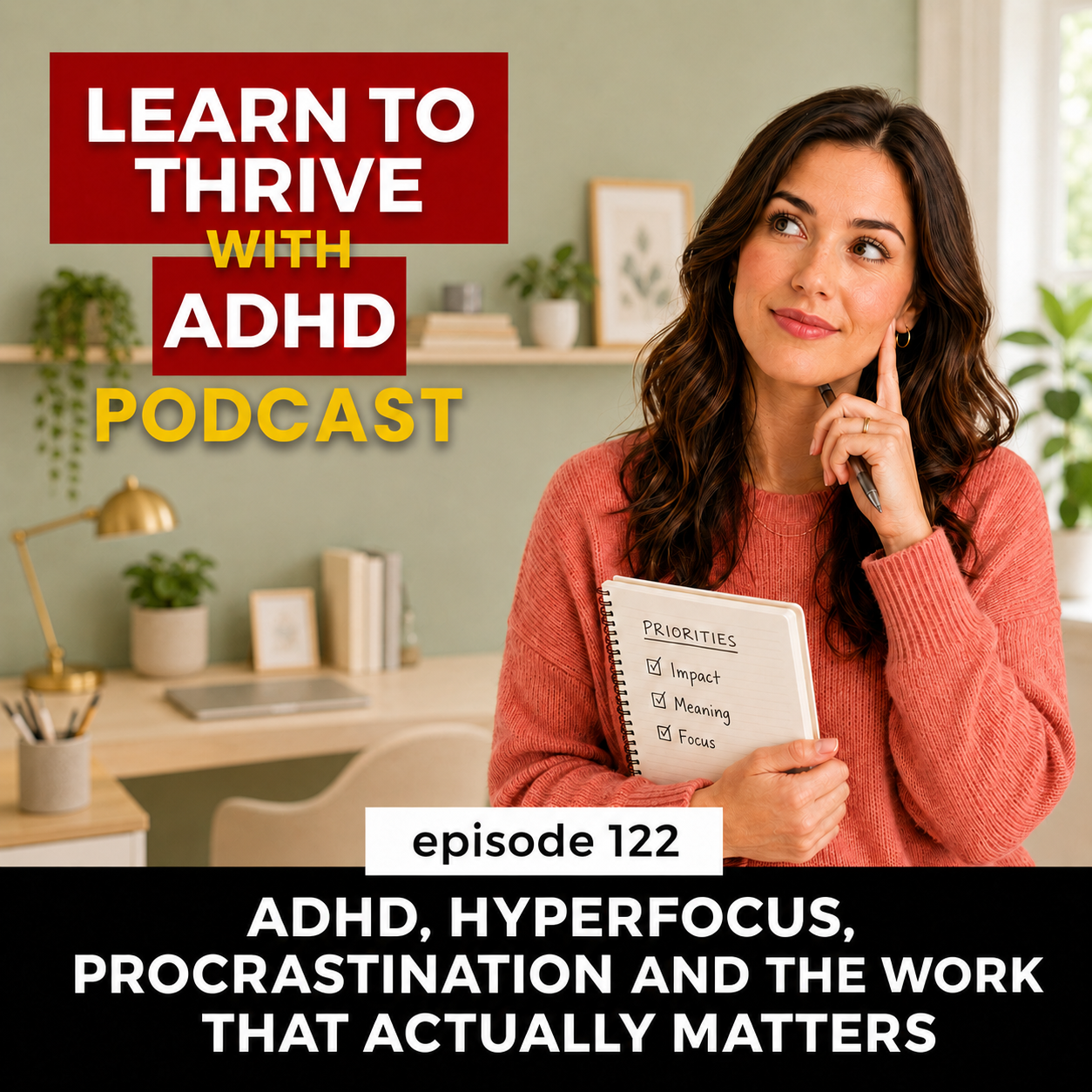
That’s ADHD hyperfocus and procrastination showing up together. And in Episode 122, Coach Mande John breaks down exactly what’s happening in your brain – and what to do about it – using Paul Graham’s essay “Good and Bad Procrastination” as a guide.
Not All Procrastination Is the Same
Most conversations about procrastination frame it as something to fix or eliminate. But Paul Graham’s essay opens with a different idea: we are always not doing something.
No matter what you choose to work on, something else isn’t getting done. So the real question isn’t “how do I stop procrastinating?” It’s “what am I procrastinating on – and does it matter?”
Graham describes three types of procrastination:
- Doing nothing
- Doing something less important
- Doing something more important
That third type? He calls it good procrastination. It’s what happens when you put off minor tasks because you’re deep in meaningful work. For ADHD brains, this reframe can take a lot of shame off the table.
When ADHD Hyperfocus and Procrastination Look the Same
Here’s where ADHD hyperfocus and procrastination get tricky: avoidance doesn’t always look like avoidance.
We answer emails. We reorganize the to-do list. We research. We clean. We optimize the plan. And because we’re doing something, it feels like productivity.
Mande calls this “procrastination wearing a productivity costume.” You’re busy – genuinely busy – but you’re avoiding the one thing that would actually move the needle.
One example from the episode: inbox zero. For some roles, managing email is essential. But for many ADHD professionals and entrepreneurs, obsessively clearing the inbox is a way to feel accomplished without doing the harder, more uncomfortable work. Not every email deserves your attention.
The better question isn’t “am I being productive?” It’s “am I working on the right thing?”
Why To-Do Lists Can Make Things Worse
To-do lists can be incredibly helpful for ADHD brains. Mande is a big advocate for offloading – getting everything out of your head and into a tool, whether that’s Trello, Google Tasks, a notebook, or even a voice memo.
When everything stays in your head, it creates constant noise. Getting it out brings real relief.
But here’s the important distinction: getting something out of your head doesn’t make it your boss.
For ADHD brains, a to-do list can quickly become a dumping ground for anxiety – a running record of everything that isn’t done, everything someone else wants from you, and everything that might matter someday. When it all lands on the same list, it starts to feel equally urgent.
That’s where overwhelm comes from. As Mande shares in the episode: overwhelm is what happens when everything gets prioritized as important.
The antidote? Defining “enough.” What is enough for today? What is enough in this season? Without that definition, there will always be more to do.
The Buckets Method: Choosing the Work That Actually Matters
One of the most practical tools Mande uses with her clients is what she calls the “buckets” method.
Imagine you’re carrying five-gallon buckets – two in each hand. You can only carry so much. Some water will spill. That’s not failure, that’s capacity.
Mande suggests identifying your 12 possible life buckets – work, family, health, home, money, relationships, business, marriage, parenting, and more – and then asking: which four buckets matter most this season?
Once you have your four, you can ask better questions:
- Which bucket needs attention right now?
- Which bucket has been neglected?
- Which bucket has a true emergency?
- What is enough in each bucket?
This shifts your focus from “I need to do everything” to “I need to keep the right water in the right buckets.” Some things will be left undone. That’s the goal – leaving the right things undone.
The Emotional Weight Behind Big Work
There’s a reason ADHD hyperfocus and procrastination often point in opposite directions. Big work is uncomfortable.
It’s often unclear. It may not give you an immediate reward. It might ask you to be visible, take a risk, or make a decision without knowing how it will turn out. It might mean tolerating the experience of being a beginner.
Meanwhile, cleaning the bathroom has a clear beginning and end. You can see the results. You get a small hit of satisfaction.
So sometimes procrastination isn’t really about the task – it’s about the emotional load attached to it. When you can name what feels hard (this feels unclear, this feels risky, I’m afraid I’ll do it wrong), you have something to work with instead of just “I’m lazy.”
Perfectionism plays a role too. When something has to be done perfectly, it becomes too big to start – and we stay busy with smaller tasks that have cleaner endings.
Building a Healthier Relationship with ADHD Hyperfocus
Paul Graham ends his essay with the idea that maybe the solution to procrastination is to let delight pull you instead of the to-do list push you.
For ADHD brains, this lands differently. Many of us know what it’s like to enter ADHD hyperfocus – to go deep into something that lights us up and make real progress in a short time. And many of us have also felt guilty about it.
Mande shares that her own relationship with hyperfocus used to be less healthy. She’d go all in on something and let everything else slide. Now the approach is different.
The shift isn’t “I can only enjoy this after everything else is done” (because everything else is never done). It’s also not “I’ll disappear into this and let my life fall apart.”
It’s: this matters to me, I’m allowed to follow this energy, and I’m going to keep up the basics while I do.
Signs hyperfocus is becoming harmful: not eating, not sleeping, not showering, avoiding responsibilities that genuinely need attention. The answer isn’t shame – it’s design. What are the minimums that need to stay in place so you can follow this energy without burning anything down?
Questions to Try This Week
Mande ends the episode with a set of reflection questions for when you feel overwhelmed or notice yourself drifting into productive-looking avoidance.
You can download the full PDF at www.learntothrivewithadhd.com/biggerwork
Here’s a preview:
- Is this an errand or is this impact?
- Am I doing this because it matters, or because it gives me quick relief?
- What is the bigger thing I might be avoiding?
- What feels scary, unclear, or emotionally loaded about the bigger thing?
- What would move the needle in this season of my life?
- What are my four buckets right now?
- What is enough in each bucket?
- What can be delegated, automated, simplified, delayed, eliminated, or done good enough?
- What is work only I can do?
And perhaps the most clarifying question of all – borrowed from Nobel Prize-winning physicist Richard Hamming:
What is the most important thing I could be working on – and why am I not working on it?
Listen to Episode 122
ADHD hyperfocus and procrastination are more connected than most people realize. This episode gives you a framework for seeing the pattern clearly – and redirecting your attention toward the work that actually moves the needle.
🎧 Listen on the podcast or watch on YouTube.
📄 Download the free reflection questions PDF: www.learntothrivewithadhd.com/biggerwork
📬 Subscribe to the weekly newsletter: www.learntothrivewithadhd.com/weekly
💼 Work with Mande: www.learntothrivewithadhd.com/services