
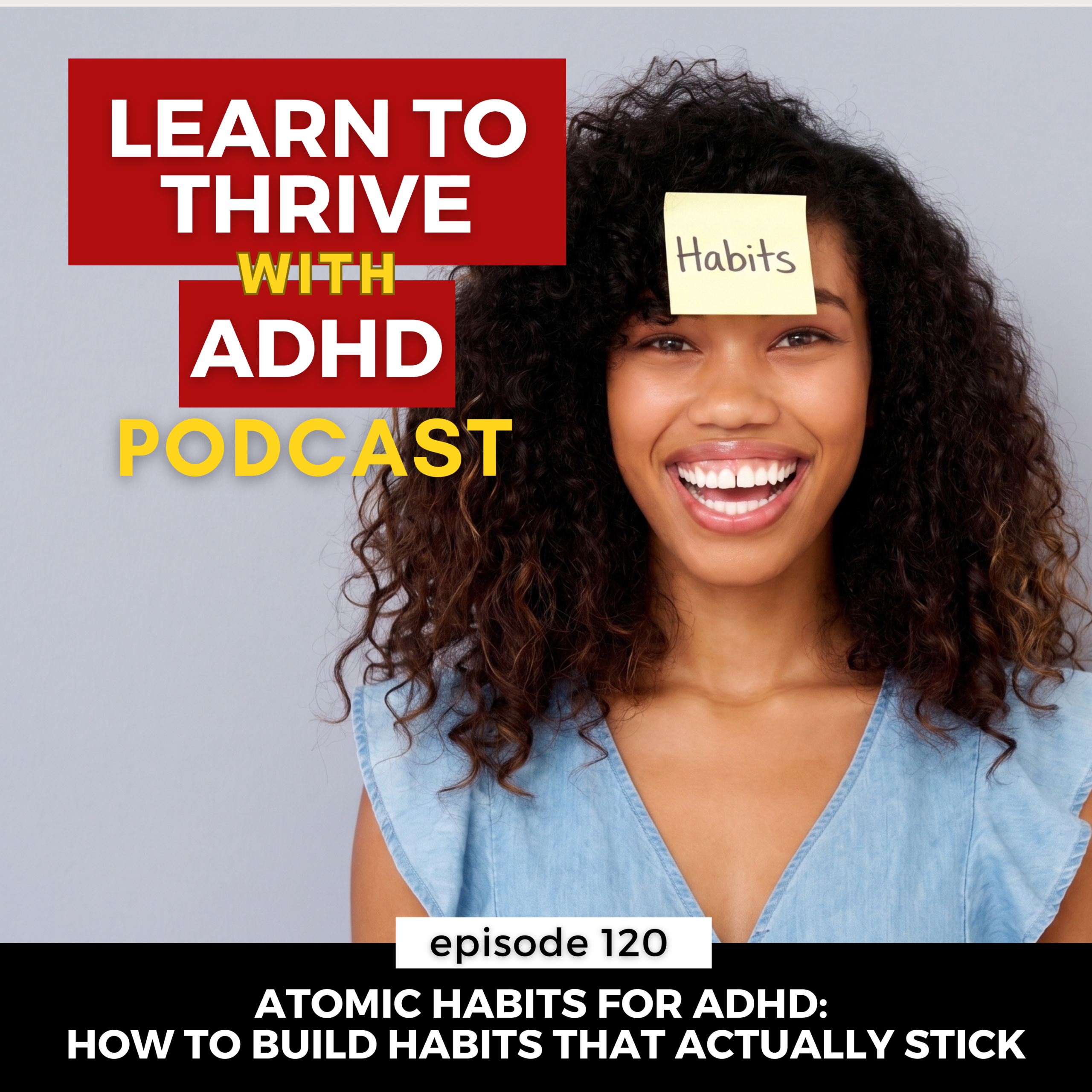




ADHD habits don’t stick because you lack discipline. They fail because traditional habit-building advice doesn’t account for how ADHD brains actually work. If you’ve ever known exactly what to do but still struggled to follow through consistently, this isn’t a character flaw – it’s an executive function challenge.
Atomic Habits by James Clear isn’t written specifically for ADHD, but many of its strategies can be adapted for ADHD. The short answer to “Does Atomic Habits work for ADHD?” is: it can be useful, especially when you make habits small, create visible cues, reduce friction, and build in reminders or support. No habit method works perfectly for everyone, and ADHD can make repetition and follow-through harder. The goal isn’t to force yourself to follow every rule in the book. It’s to use the parts that make your next step easier.
And that’s a much more helpful conversation for ADHD. For practical ways to turn small habits into repeatable structures, read five essential ADHD-friendly routines.
Why ADHD Makes Consistency Hard
From the outside, it can look like you should be able to do something. Especially if you know what needs to be done.
And yet, actually doing it consistently can still feel incredibly hard.
That disconnect is frustrating. You might know the steps. You might agree with the goal. You might really want the outcome. And still find yourself not starting, not following through, or not repeating the behavior long enough for it to stick.
This is where ADHD habits get misunderstood. The issue isn’t a lack of desire. It’s that ADHD affects executive function – and executive function is what helps us do the very things habits require in the beginning:
- Getting started
- Remembering at the right time
- Prioritizing
- Shifting attention
- Tolerating boredom
- Following through when the task is no longer new or interesting
Even when something is simple in theory, it can still be hard in practice.
And that’s why consistency feels so personal for so many people with ADHD. It’s not just that we forgot to do something. It’s that we often judge ourselves for struggling with the exact things that ADHD makes harder.
We tell ourselves: “If it mattered enough, I would have done it. If I were more disciplined, I would have stuck with it.”
But that way of looking at it misses what’s actually going on. ADHD creates real barriers to consistency – especially when something is repetitive, boring, delayed in reward, mentally effortful, or easy to ignore in the moment.
ADHD habits take more support, more intention, and more trial and error than people realize. And that doesn’t mean you’re broken. It means you need an approach that takes your brain into account.
ADHD Habits Reduce Executive Function Load
Here’s why habits can be incredibly powerful for ADHD: they reduce how often we have to rely on executive function in the moment.
Executive function is expensive for ADHD brains. It takes energy. It takes effort. It takes remembering, deciding, initiating, organizing, and following through – sometimes all at once.
When something is not yet a habit, we have to manually make it happen every single time. We have to remember it. Decide to do it. Get ourselves started. Stay with it. That’s a lot.
But when something becomes more habitual, there’s less friction. Less debate. Less starting from scratch. Less trying to recreate the wheel every single day.
The behavior becomes more familiar, more automatic, and easier to return to.
This is one of the biggest reasons ADHD habits can be life-changing. They lower the amount of mental energy required to do the things that support us.
For me, one of the most important habits I built was to plan, check my plan, and honor my plan using Google Calendar.
The important part wasn’t the tool itself. The important part was that I created a repeated system I could rely on. Instead of constantly trying to remember everything in my head or decide in the moment what I should be doing, I had a structure to return to.
And over time, that structure became more natural. It didn’t happen overnight. But it made a huge difference.
That’s why ADHD habits aren’t just nice little add-ons. They’re foundational. Because if we can turn a supportive behavior into something more automatic, we’re no longer depending entirely on our most effortful brain functions to get through daily life.
We’re creating systems that help us do what we already want to do.
Choose One Keystone Habit and Start Small
One of my favorite ideas from Atomic Habits is the keystone habit – the habit that helps hold others up. It creates a ripple effect. It makes other helpful behaviors easier, more likely, or more natural to follow through on.
This matters so much for ADHD because one of the biggest mistakes we make is trying to fix everything all at once.
We’re very aware of all the areas that feel harder: time management, meal planning, sleep, exercise, cleaning, paperwork, routines, emotional regulation, follow-through.
So when we decide we want things to change, it’s very easy to go into overhaul mode. We want a full reset. We want to do everything differently starting now.
And usually that doesn’t last. Too many decisions. Too much pressure. Too much effort. Too many places to fall off.
That’s why keystone habits are such a powerful concept. They help you stop asking “How do I fix my whole life?” and start asking “What is the one habit that would make several other things easier?”
Examples of Keystone Habits:
For me: Planning on my digital calendar became a keystone habit because it supported time management, follow-through, and reduced chaos.
For a client: Working out regularly, because she felt like if she did that, she would eat healthier and be more mindful in other ways too.
For someone else: Going to bed at a certain time, meal prepping, or doing a Sunday reset.
This is what makes ADHD habits ADHD-friendly: Instead of trying to build ten habits at once, you look for the one with the most leverage. And then you start smaller than you think you need to.
Another thing Atomic Habits gets right: change doesn’t have to be dramatic to count. Small changes matter. Small behaviors, repeated over time, can create meaningful results.
And that matters so much for ADHD brains because small changes are easier to start, easier to repeat, and easier to come back to after interruption.
Big overhauls require a lot of activation energy. Small habits ask less of us. They create less resistance. They leave more room for real life.
For me, getting into the habit of time management took two years. That’s longer than what people usually want to hear. But honestly, who cares? If it took two years and now I have a habit that supports me, that’s still a win.
I would much rather take longer and actually solve the problem than rush the process and still be struggling years later.
Small doesn’t mean insignificant. And slow doesn’t mean failing. Sometimes small is exactly what makes the habit possible. And sometimes slow is exactly what makes it sustainable.
Troubleshoot ADHD Habits Instead of Blaming Yourself
One thing I really appreciate about Atomic Habits is that it doesn’t just tell you to do better. It gives you a framework for understanding why a habit is or isn’t working.
The book breaks habits down into four parts: cue, craving, response, and reward.
- Something has to remind you (cue)
- Something has to make the behavior feel appealing enough to do (craving)
- The behavior itself has to be doable (response)
- There has to be some kind of satisfying payoff at the end (reward)
This breakdown is so useful because it gives you something to examine besides your own worth.
Instead of saying “Why can’t I ever get it together?” you can ask:
- Is the cue strong enough?
- Is this too hard to start?
- Is there too much friction?
- Is the reward too delayed?
- Am I expecting my brain to do something it’s not actually supported to do right now?
That’s such a different conversation. It moves you out of shame and into problem-solving.
If you keep forgetting ADHD habits, maybe the cue is too weak.
If you keep avoiding something, maybe the habit is too big, too boring, or too disconnected from any immediate payoff.
If you keep falling off after a few days, maybe the system is relying too heavily on motivation instead of repetition, support, and design.
This is especially important for people with ADHD because we often do better when things are visible, concrete, and specific.
Vague advice like “just be more consistent” isn’t helpful. But a framework that says, “Let’s look at what’s triggering the behavior, what’s getting in the way, and what would make it easier to repeat” – that’s helpful.
All ADHD support should work this way. Less blame. More troubleshooting. Less pressure to prove yourself. More curiosity about what your brain actually needs in order to follow through.
When you understand that a system can fail without you being a failure, it becomes so much easier to keep experimenting, keep adjusting, and keep building ADHD habits that actually fit your life.
Use Environment, Support, and Reward for ADHD Habits
One of the most helpful ideas in Atomic Habits is that behavior is shaped so much by environment.
For ADHD, this is especially important because so many of us have spent years trying to manage everything with willpower. We try to remember things in our heads. We try to push through resistance. We try to force ourselves to be consistent just because we said we would.
But the environment around us matters a lot more than people think.
The book talks about making cues visible and obvious, because the easier something is to see, the easier it is to remember and respond to it.
For ADHD: out of sight really can become out of mind.
If the thing that’s supposed to support you is tucked away, hidden, buried in a drawer, or living only in your memory, there’s a good chance it’s not going to happen consistently.
But when the cue is right in front of you, it takes less effort to remember and less effort to get started.
The Mindset Shift for ADHD Habits:
Instead of asking “Why can’t I just remember?” ask “How can I make it harder to forget?”
Instead of asking “Why am I not doing this consistently?” ask “What in my environment is making this harder than it needs to be?”
That might look like:
- Putting something where you will trip over it
- Leaving a visual reminder in the place where the action needs to happen
- Opening the app before you need it
- Setting up tomorrow’s task tonight
- Making the first step so obvious that your brain doesn’t have to go searching for it
Those changes can seem small, but they matter. They reduce friction. They make the cue stronger. They give your brain something concrete to respond to.
ADHD Habits Need External Support
People with ADHD often need more outside support than they’ve been taught to ask for. And I don’t mean that in a negative way.
A lot of ADHD-friendly strategies work because they take something that would otherwise have to stay in your head and put it somewhere outside of you.
That’s one reason tools like habit tracking, reminders, calendars, accountability, and visual systems can be so helpful. They give the habit something to attach to outside of your memory alone.
When you track something, even in a very simple way, it becomes more visible. It’s no longer just a vague intention floating around in your mind. You can actually see whether it happened.
Accountability can help in a similar way – not in a shame-based way, but in a supportive way. Sometimes simply knowing that someone else is aware of what you’re working on helps hold the habit in place.
If something works better because you wrote it down, set it up visually, had someone check in with you, or built accountability into the system – that doesn’t mean you’re less capable. It means you understand what helps your brain stay connected to the habit.
ADHD Habits Need Reward
One of the biggest problems with relying on motivation is that motivation changes. Some days you feel focused, energized, and ready to go. Other days everything feels harder.
That’s true for most people, but especially true with ADHD. Interest can fluctuate. Energy can fluctuate. Urgency can drive us one day and disappear the next.
So if a habit only happens when we feel like doing it, it’s probably not going to happen consistently.
That’s why one of the most useful parts of Atomic Habits is the idea that habits are more likely to stick when they feel satisfying and rewarding.
A lot of ADHD struggles happen in the gap between what matters long term and what feels compelling right now. We may absolutely care about the future outcome. But if the task in front of us feels boring, effortful, repetitive, or too delayed in payoff, it can be very hard to engage with it in the moment.
This doesn’t mean we’re lazy. It means our brain responds strongly to what feels interesting, novel, urgent, or immediately rewarding.
So if we want ADHD habits to last, it helps to build in something that makes them feel better to do.
That might look like:
- Only listening to a favorite podcast while cleaning
- Making planning time feel cozy and enjoyable instead of rigid and punishing
- Creating a little ritual around the habit so it feels more inviting
- Figuring out how to make waking up earlier enjoyable
The point is not to bribe yourself because you’re incapable. The point is to work with your brain instead of against it.
Adding some form of immediate satisfaction, even something small, can help bridge the gap between delayed long-term benefits and what your brain needs to come back right now.
Make ADHD Habits Easier Than You Think They Need to Be
Another reason this book is so helpful for ADHD is because it really emphasizes making habits easier, not more impressive.
We tend to believe that if a goal matters, we should go big. We should prove we’re serious.
So instead of saying “I’m going to stretch for two minutes,” we say “I’m going to work out for an hour every day.”
And then when we don’t follow through on the giant version, we feel like we failed.
But the truth is, for a lot of people with ADHD, the hardest part is not the habit itself. It’s getting started.
It’s crossing that invisible line between intending to do something and actually doing it.
That’s why I love the book’s focus on reducing friction and using the two-minute rule – making the habit so easy to begin that it no longer feels like a huge mountain your brain has to climb.
Activation can be such a challenge with ADHD. A task can be small and still feel enormous if it takes too much effort to begin.
So when you shrink the habit down to something almost laughably doable, you’re not lowering the value of the habit. You’re lowering the barrier to entry.
Reading two pages might not sound impressive, but it’s a lot more effective than repeatedly planning to read twenty and never opening the book.
Putting on your workout clothes may seem tiny, but it’s still movement toward the habit. It still counts. And often once you begin, it’s much easier to keep going.
The Tiny Version Is the Doorway
People sometimes misunderstand small habits. They think the goal is the tiny version forever.
But really, the tiny version is the doorway. It’s the way in. It’s what helps you establish the pattern, reduce resistance, and create momentum.
Once the habit exists, it can grow. But if you make the entry point too hard, you may never build the pattern at all.
The most ADHD-friendly question you can ask is not “What is the ideal version of this habit?” but “What is the easiest version I can actually repeat?”
What version still counts? What version can I do even on a low-energy day, a chaotic day, or a day when my brain is not cooperating much?
Because that’s the version most likely to become real. And in the long run, real is always more useful than ideal.
It May Take Longer for ADHD Habits (And That’s Okay)
So much shame comes from how we measure progress with ADHD habits. We don’t just want things to work. We want them to work quickly.
And when that doesn’t happen, it’s very easy to assume the problem is us. We tell ourselves: “If this were really going to work, it would have worked by now. If I were capable, it wouldn’t be taking this long.”
But I don’t think that’s true.
Habits can absolutely be more challenging for those of us with ADHD to develop. There’s often more friction at the beginning. More inconsistency. More forgetting. More restarting. More trial and error.
And I think we need to be honest about that – not in a discouraging way, but in a compassionate way.
When we pretend it should be just as easy for everyone, people with ADHD end up blaming themselves for the extra effort something takes.
Sometimes it does take longer. Sometimes the habit doesn’t become natural quickly. Sometimes you have to rebuild it over and over before it finally sticks.
That doesn’t mean you’re failing. It means you’re not necessarily wired like the people you’re comparing yourself to.
What if the timeline is not the most important thing? What if the better question is not “How fast did I build this habit?” but “Did I eventually build something that actually supports me?”
Because if the answer is yes, then in the end you’re not going to care how long it took you to get there.
This is a really important mindset shift for ADHD habits:
We have to stop using speed as the main measure of whether something is working.
- Slow progress is still progress.
- Repeated restarts don’t erase the fact that you’re learning.
- Needing more support doesn’t mean the habit isn’t real.
- Taking longer doesn’t make the result any less valuable.
If anything, it may mean you had to build it more intentionally, with more awareness of what actually works for you.
If you’re someone who has tried to build ADHD habits and felt discouraged because it takes you longer than you think it should, I really want to say this clearly:
Longer doesn’t mean impossible. Longer doesn’t mean broken. Longer doesn’t mean you’re not capable of change.
It may simply mean that your process needs more repetition, more patience, and more support than the culture usually allows for. And that’s okay.
The goal is not to build habits on someone else’s timeline. The goal is to build habits that truly help you live your life.
Key Takeaway
When I look at Atomic Habits through the lens of ADHD, what stands out most is that this is really a book about reducing friction between what you want to do and what you actually do.
For people with ADHD, that gap can feel enormous. We can care deeply about something and still struggle to start. We can know exactly what would help us and still not follow through consistently.
That’s why ADHD habits matter so much.
When they’re built in a way that actually works for your brain, they can help close that gap. Not because habits make ADHD disappear. Not because building them is always easy. But because they can make supportive behaviors easier to return to.
They can create structure where there used to be chaos. They can give you something to lean on when your brain is tired, distracted, overwhelmed, or not especially cooperative.
Habits aren’t about becoming a perfect person. They’re about making life more doable.
Don’t underestimate the power of a small habit that truly supports you. Don’t dismiss a system just because it looks simple. Don’t assume something isn’t working just because it’s taking longer than you hoped.
The goal is not to force yourself into someone else’s way of functioning. The goal is to build systems that make your life easier to follow through on.
And if a habit helps you do that, even in a small way, that matters. That counts. And over time, it can change much more than you think.
Resources
🎧 Listen to the Full Episode: Atomic Habits for ADHD: How to Build Habits That Actually Stick
📖 Book: Atomic Habits by James Clear
📬 Weekly ADHD Newsletter: learntothrivewithadhd.com/weekly
📱 Instagram: @learntothrivewithadhd
👉 Book a Free Coaching Consultation: learntothrivewithadhd.com/services
Click here to listen to the episode or Watch the YouTube episode here