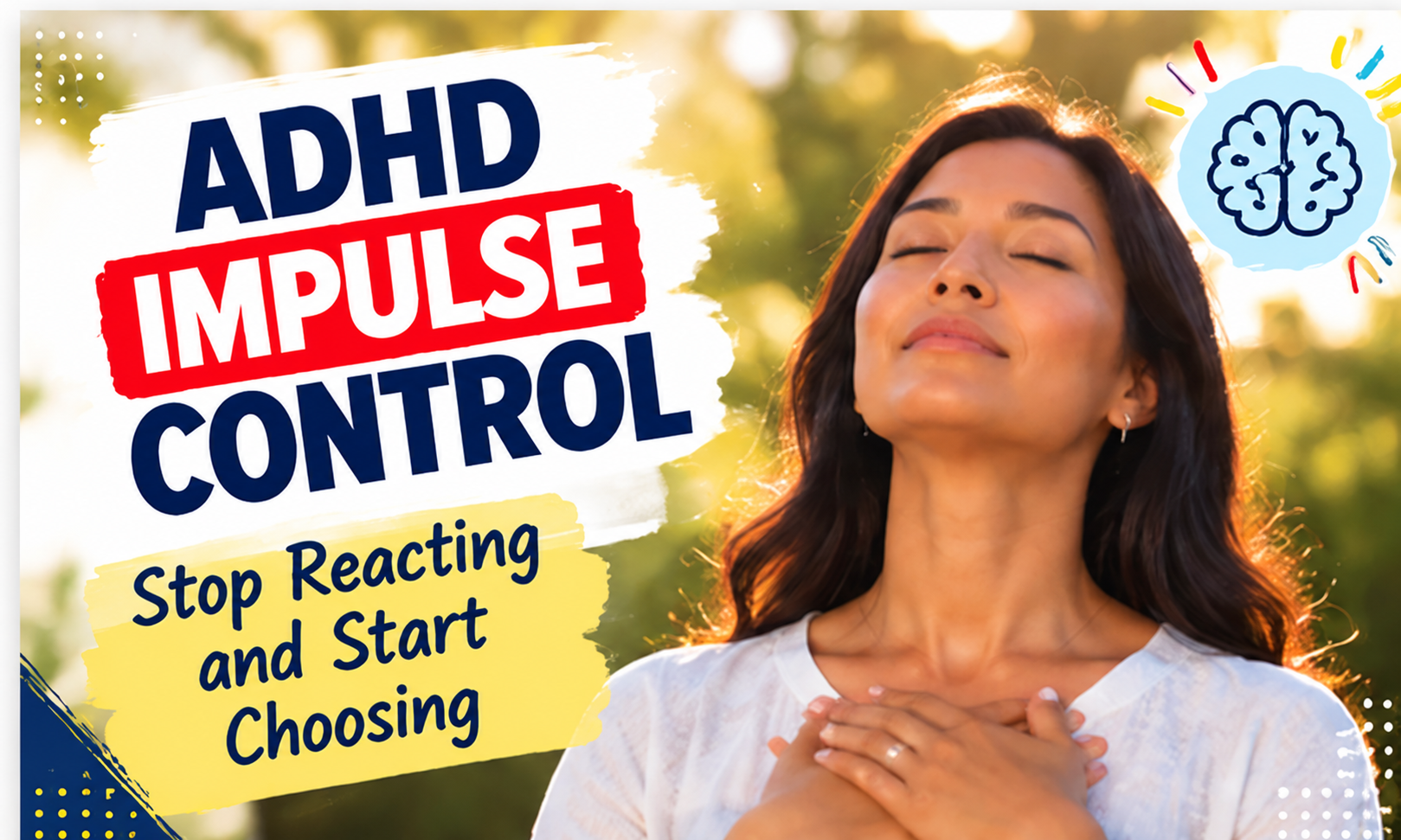
You’re standing in the fridge. Again.
You know you’re not hungry. You know you’re avoiding something. But your hand is already reaching for food.
Or maybe it’s the snooze button. You told yourself you’d get up. You set an intention. But your arm moved faster than your decision could catch it.
For adults with ADHD, this is impulse control in action—or rather, the struggle with it.
The challenge isn’t simply willpower or character. ADHD can make it harder to pause and inhibit an immediate response. Your impulses may feel automatic rather than deliberate. Sometimes you realize what’s happening only after you’ve already acted.
And then comes the shame: “Why did I do that again? What’s wrong with me?”
Here’s what I want you to know: Nothing is wrong with you. Your nervous system just needs support, not judgment.
What is impulsive responding in ADHD? It’s acting on an urge before you’ve had time to pause and consider what you want to do. It might look like interrupting, making an unplanned purchase, switching tasks, or snapping when you’re frustrated. ADHD can make that pause harder because impulse control is one of the executive function skills it affects. Can people with ADHD improve impulse control? Yes. ADHD can make it harder to stop an automatic response, but you can practice noticing impulses earlier and put supports in place before a difficult moment. In this guide, we’ll look at seven practical strategies—including a pause before purchases, physical reminders, prepared responses, and self-soothing—to help you create more space between an impulse and your response. The goal isn’t to never have an impulse. It’s to give yourself more opportunities to choose what happens next.
What Is ADHD Impulse Control (And Why It Matters)?
ADHD impulse control is your ability to pause, think, and choose—rather than reacting automatically.
For most people, there’s a gap between feeling an impulse and acting on it. You feel hungry. You consider if you’re actually hungry or just bored. You decide whether to eat.
With ADHD, that gap shrinks. Sometimes it disappears entirely.
The Speed Problem
Research links ADHD with difficulties in inhibiting automatic responses, and some people with ADHD also experience challenges regulating strong emotions. The experience varies from person to person, but it can make pausing before you act harder.
This isn’t about character. This isn’t laziness or immaturity. This is neurology.
ADHD involves differences in brain networks that support attention, self-regulation, and inhibitory control. Dopamine signaling and prefrontal brain functions are part of that picture, but it isn’t as simple as every ADHD brain having less dopamine or thinking faster. In everyday life, it can feel like your reaction happens before you’ve had a chance to consider your options.
Why This Matters in Real Life
Poor ADHD impulse control doesn’t just mean small inconveniences. It shows up as:
Financial stress – Impulsive spending without considering consequences Health issues – Eating when not hungry, skipping sleep to avoid tomorrow’s stress Unfinished projects – Switching tasks because the current one feels uncomfortable Relationship strain – Saying things you didn’t mean in moments of frustration Work challenges – Interrupting, blurting out, switching priorities constantly Shame spiral – The familiar feeling of “Why did I do that again?”
The catch: These aren’t failures. They’re impulse control challenges masquerading as motivation problems.
Why ADHD Brains Struggle with Impulse Control
Understanding why you struggle with impulse control and ADHD is the first step to changing it.
It’s Not About Willpower
This is crucial: ADHD impulse control problems are not about motivation or discipline.
You can care deeply about your goals and still struggle with impulse control. You can be highly motivated and still hit snooze. You can want to save money and still spend it impulsively.
Willpower isn’t the issue. Speed is the issue.
The Neurological Reality
Several challenges can contribute to impulsive responses in ADHD:
- Reward and motivation differences – Immediate rewards can sometimes feel more compelling than distant benefits
- Differences in inhibitory control – Pausing or stopping an automatic response may take more effort
- Emotional regulation challenges – Some people with ADHD find strong feelings harder to manage in the moment
- Difficulty with future-oriented thinking – The future benefit feels distant; the present urge feels urgent
When boredom, frustration, discomfort, or stress shows up, an immediate escape or reward can feel especially appealing. For some adults with ADHD, pausing before acting takes extra effort. That’s a self-regulation challenge, not a character flaw.
Emotional Impulsivity: The Hidden Struggle
Many people think impulse control is just about behavior—spending money, interrupting, switching tasks.
But emotional impulsivity is often the bigger challenge.
Emotional impulsivity means your feelings escalate quickly. Frustration becomes anger. Disappointment becomes despair. Excitement becomes overwhelm. And you react from that heightened emotional state before you can even process what you’re feeling.
Strong feelings can sometimes seem to arrive all at once. When you’re upset, it may be harder to pause and think through your response. That doesn’t mean the thinking part of your brain switches off entirely; it means you may need more support and practice to respond the way you want to.
This is why people with ADHD are:
- More difficulty waiting or tolerating delays
- Quick to feel frustrated in challenging situations
- More likely to react before pausing when emotions run high
Again: This is not character. This is emotional dysregulation.
How ADHD Impulse Control Shows Up in Real Life
Impulse control challenges aren’t one-size-fits-all. Let’s look at where it actually appears:
The Snooze Button Problem
Hitting snooze is a perfect example of impulse control in action.
In that moment, you’re not making a thoughtful decision. You’re responding to an immediate impulse: “I want comfort. I want to keep sleeping. I don’t want to face the day.”
The future benefit of getting up (accomplishing your day, feeling productive) feels distant. The immediate comfort of sleep feels very close and very real.
Here’s what people miss: Sometimes the snooze button isn’t about laziness. It’s about avoiding stress or dread.
You’re anxious about your day. There’s an uncomfortable task waiting. The snooze button feels like relief—even though it creates more stress later.
Impulsive Spending and Financial Stress
One of my biggest ADHD impulse control struggles was spending money.
In college, my student ID doubled as a credit card. If I wanted something, I bought it. If I thought about something, I bought it. Small purchases, big purchases—it didn’t matter. There was no pause between impulse and action.
My husband did the same thing. Between student loans and credit cards, we accumulated $90,000 in debt.
We made a massive life change. We sold almost everything we owned and moved into a small trailer with our four-year-old son. And that’s when I realized something crucial:
My spending wasn’t about the purchases. It was about how I was feeling.
Sometimes I was chasing a good feeling (dopamine hit, excitement, novelty). Sometimes I was avoiding a bad feeling (boredom, anxiety, stress). The moment I understood this connection, everything changed.
Eating When You’re Not Hungry
This works the same way.
You’re not eating because you’re physically hungry. You’re eating to:
- Avoid a task
- Self-soothe stress
- Distract from an uncomfortable emotion
- Fill boredom
The impulse happens fast. You’re already standing in the fridge before you realize what you’re doing.
Task Switching and Work Chaos
You sit down to work on something important. Your intention is clear. Your priority is set.
Then an email notification appears. Or you remember something else. Or you think, “I’ll just do this other thing really quick.”
That moment—that urge to switch—is impulse control.
What you’re actually looking for is relief, novelty, or a quick win. These “triggers” are actually unnamed emotions: boredom, frustration, overwhelm, discomfort.
Sometimes switching tasks is a way to escape frustration or discomfort. Other times, distraction or difficulty sustaining attention plays a bigger role. If intense emotions are part of the pattern, read Why Do My Emotions Feel So Intense With ADHD?. If you struggle with changing gears, explore ADHD task switching.
One hour later, you’ve answered emails, reorganized files, started three different projects, and haven’t touched your actual priority. That’s impulse control showing up in your work.
Interrupting and Blurting Things Out
For professionals and people in leadership roles, this impulse control struggle can be especially painful.
With ADHD, there’s an urgency: “If I don’t say this now, I’ll forget it.”
That’s not disrespect. That’s the ADHD brain managing its own limitations. Internally, this feels urgent—like pressure building in your body or chest. There’s often a thought: “If I don’t get this out now, I’ll lose it.”
That urgency is part of the impulsivity. Your brain is trying to protect the thought before it disappears.
Emotional Reactions in Relationships
This is where impulse control gets really painful.
Yelling at your kids when you didn’t mean to. Snapping at your partner. Saying harsh things and then spending the rest of the day regretting it.
I used to yell at my kids, and I hated it. I thought I was a bad parent. Eventually, I realized something: I was yelling almost entirely out of fear.
Fear that I was parenting wrong. Fear that I was messing them up. Once I named that fear, my impulse to yell diminished dramatically.
The pattern: Behind most impulsive emotional reactions is an emotion you haven’t named yet. Name the real feeling, and the reaction that didn’t fit suddenly makes sense.
Awareness: Where ADHD Impulse Control Change Starts
Here’s something crucial to understand:
With ADHD impulse control challenges, awareness often comes AFTER the behavior, not before.
You’re already spending the money. You’re already standing in the fridge. The words already came out of your mouth.
And this is where shame creeps in: “I should have known better. I should have stopped myself.”
But here’s the truth: Catching it after still counts.
The Awareness Timeline
With ADHD impulse control, there’s usually a progression:
Stage 1: After the behavior – You realize what you did once it’s already over. You’re reflecting after the fact.
Stage 2: During the behavior – You start catching it as it’s happening. You’re already in the fridge, but now you notice.
Stage 3: Before the behavior – Eventually, sometimes, you catch the impulse before you act.
If you usually notice an impulse only after you’ve acted, that’s a useful place to begin. Noticing what happened gives you information you can use next time.
Why This Matters
When you catch an impulse after you’ve acted on it, that’s not failure. That’s awareness building. That’s your nervous system beginning to develop a new skill.
Shame can make it harder to reflect on what happened. When you move straight from reacting to self-criticism, you may stay caught up in the emotion instead of noticing what could help next time. A little time to settle can make it easier to think through your options.
This is why self-soothing matters more than willpower.
Practical ADHD Impulse Control Strategies That Work
These aren’t motivation tips. These are system changes that create space between impulse and action.
Strategy 1: The Shopping Cart Pause
For impulsive spending:
When you want to buy something online, add it to your cart instead of buying it immediately. Then close the window and walk away.
Come back a day or two later.
Most of the time, the urge is gone.
Here’s why this works: You’re not using willpower. You’re using time. You’re creating a pause that gives your nervous system time to settle. The impulse that felt urgent yesterday often feels manageable today.
Waiting gives you room to reconsider the urge. What feels urgent right now may feel less compelling tomorrow, when you have more distance from the moment.
Strategy 2: The Fridge Check-In
For emotional eating:
Instead of trying to stop yourself from eating (willpower approach), turn the fridge into a checkpoint.
Every time you open the fridge, pause and ask:
- Am I actually hungry?
- What am I feeling right now?
- What am I trying to avoid?
- What feeling am I trying to create?
If the answer isn’t hunger, the next question becomes: How else can I meet this need?
You’re not suppressing the impulse. You’re making it conscious. You’re creating the pause by making the moment deliberate instead of automatic.
Strategy 3: Physical Anchors for Interrupting
For blurting and interrupting:
Dr. Russell Barkley talks about “externalizing what you can’t internalize.” For ADHD impulse control, this is crucial.
Physical anchors create an external pause:
- Hold a small object in your pocket and turn it over in your hand while listening
- Turn a ring on your hand
- Press your palm flat on the desk
- Hold a pen and take notes
The physical action becomes a reminder to pause. This isn’t about suppressing yourself. It’s about supporting your brain in real time. You’re giving yourself an external cue to do what your internal system is struggling to do: pause.
Strategy 4: Pre-Programming Your Responses
For work impulses:
Ask yourself before a challenging situation: “Who do I want to be in that moment?”
Thinking through a challenging situation ahead of time gives you a response to practice. When that moment comes, you have a plan to reach for instead of having to invent one under pressure.
Examples:
- “In meetings, I want to be someone who listens first and speaks after thinking.”
- “When stressed, I want to be someone who takes a break instead of yelling.”
- “With difficult emails, I want to be someone who waits 24 hours before responding.”
Strategy 5: Reflection, Not Judgment
After an impulsive moment:
There’s a huge difference between judgment and reflection.
Judgment: “Why do I always do this? What’s wrong with me?” (This can keep you focused on blame rather than what you can change.)
Reflection: “Okay, that happened. What was going on? What triggered it? What could I try differently next time?” (Nervous system can settle. Learning can happen.)
Reflection is also noticing positive progress:
- “I noticed I caught it sooner today.”
- “I paused longer this time.”
- “I named the feeling before reacting.”
These small wins matter. Each time you notice a pattern or practice a pause, you’re giving yourself another opportunity to respond differently.
Strategy 6: Self-Soothing for Regulation
This is the step most people skip, and it’s critical:
After an impulsive moment, you might still feel upset or on edge. Harsh self-criticism can add to that stress. Taking a moment to settle may help you reflect and decide what to try next time.
Self-soothing isn’t about letting yourself off the hook. It’s about calming your nervous system so your brain can actually learn from what happened.
Self-soothing might look like:
- Deep breathing
- A few minutes outside
- Gentle movement
- Talking to yourself with compassion
- Physical touch (hand on heart)
Regulation has to come before change.
Strategy 7: Meditation and Mindfulness
Meditation isn’t about stopping your thoughts or calming down (though it can help with that). It’s about practicing noticing what’s happening without immediately reacting.
This creates a tiny gap between emotion and reaction. That gap is where choice lives.
But here’s what’s equally powerful: Developing awareness throughout your day through mindfulness—noticing your thoughts and emotions without judgment, noticing urges without reacting immediately—trains your brain all day long to pause.
You don’t need to meditate for an hour. You’re pre-programming your brain through real-time awareness practice.
Understanding the ADHD Ferrari Brain with Bicycle Brakes
One way to picture ADHD impulse control is a powerful engine with brakes that need extra support. It’s a metaphor, not a literal description of how an ADHD brain works.
You have:
- A powerful engine (creativity, quick thinking, ability to hyperfocus)
- Very weak brakes (impulse control struggles)
In this metaphor, the challenge isn’t having a powerful engine. It’s having enough support to slow down and steer when you want to.
And here’s the useful part: You don’t have to rely on willpower alone. You can build supports that make pausing easier.
That’s what all these strategies are: different brakes. External systems that create the pause your internal system struggles to create.
The Progress Paradox: Building Better Impulse Control Over Time
Here’s something important: Stress and exhaustion make impulse control harder.
You might notice that when you’re:
- Sleep-deprived
- Stressed about deadlines
- Going through emotional situations
- Physically overwhelmed
Your impulse control seems to disappear.
This doesn’t mean you lost progress. It means you’re human.
Progress with ADHD impulse control isn’t a straight line. It’s more like stairs with plateaus and occasional steps backward. When you’re overwhelmed, you’re not starting from zero. You’re just operating from a higher stress baseline.
Celebrate the Progress You’re Actually Making
Progress with ADHD impulse control might look small:
- Catching it one second sooner
- Pausing for five seconds longer
- Naming the feeling before reacting
- Reflecting instead of judging
These small shifts give you more chances to practice a different response. Over time, that practice can make the next pause feel more familiar.
The Path Forward: From Impulse to Choice
If you’re reading this thinking, “None of these impulse control strategies are working yet,” here’s what I want you to know:
Awareness usually comes after the behavior before it ever comes before.
You might catch your impulse after you’ve acted on it for months or even years. Then slowly, gradually, you start catching it during. Eventually, sometimes, you catch it before.
That progression is normal. That progression is progress.
ADHD impulse control isn’t about stopping impulses. It’s about learning how to work with them.
Creating that space between feeling and action. Finding systems that externalize what your brain is struggling to internalize. Replacing judgment with reflection. Building regulation before expecting change.
And I want to assure you: You can improve beyond what you might think possible.
Key Takeaways
- ADHD impulse control is about self-regulation, not character. Difficulty pausing before a response can be part of ADHD. It isn’t a moral failure.
- Emotional impulsivity can be a major struggle. For some people with ADHD, strong feelings make it harder to pause before responding.
- Awareness often comes after the behavior. This still counts. This is where change starts.
- Systems matter more than willpower. Create external structures (shopping cart pause, check-ins, physical anchors) that support your impulse control.
- Regulation before change. Self-soothing and reflection matter more than judgment and pushing yourself harder.
- Progress is better than perfection. One pause at a time. One small shift at a time.
- Give yourself better brakes. Instead of relying only on willpower, use reminders, pauses, and other supports that make it easier to choose your response.
PIN THIS: ADHD Impulse Control Foundation
When impulse control is hard:
Pause (even if it’s after the fact) → Notice what happened → Name the feeling → Reflect (don’t judge) → Self-soothe → Try something different next time
Remember: One pause at a time. One second longer. One small shift.